
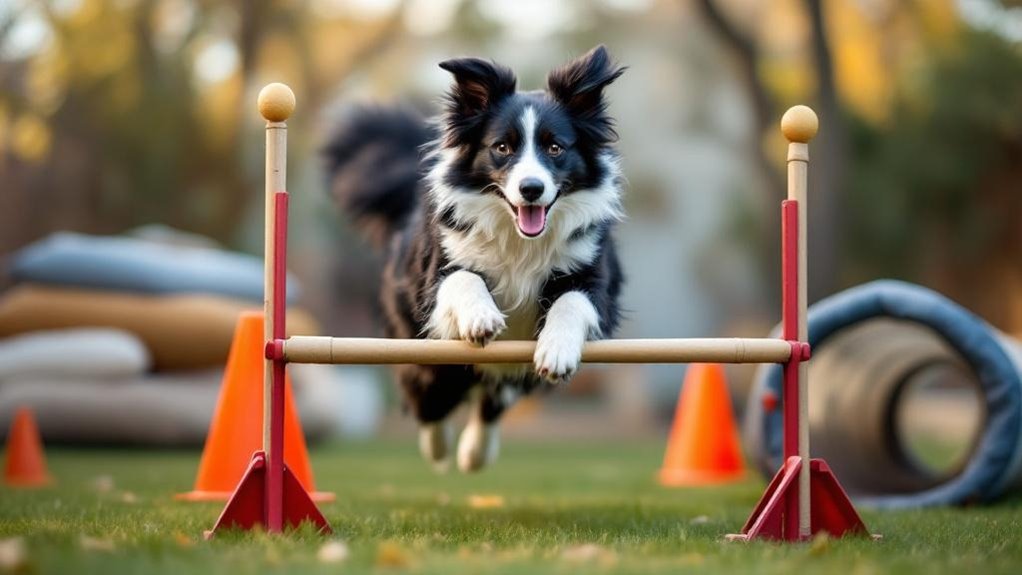
Your Border Collie’s mind is a fast engine, and home agility gives it a track without draining your wallet. You can start with simple gear, short sessions, and clear rewards. Safety comes first, since speed and drive can turn small mistakes into strain. With the right setup, you’ll build focus, control, and confidence in your own yard. The next step is knowing what to use and what to avoid.
- Key Takeaways
- Why Border Collies Excel at Agility
- Is Home Agility Safe for Your Dog?
- When Agility Is Not the Right Fit
- Adjust Agility for Age and Fitness
- Pick a Safe Backyard Training Space
- Set a Simple DIY Agility Budget
- Gather Low-Cost Agility Supplies
- Teach Basic Agility Cues First
- Build a Cheap Jump at Home
- Make Low-Cost Weave Poles
- Create a Simple Backyard Tunnel
- Use Planks for Balance Training
- Add a Pause Table for Control
- Teach One Obstacle at a Time
- Use Treats and Praise Effectively
- Link Obstacles Into Short Sequences
- Increase Difficulty Safely
- Avoid Common Home Agility Mistakes
- Frequently Asked Questions
- Conclusion
Key Takeaways
- Get veterinary clearance before agility, especially for puppies, seniors, or dogs with hip, elbow, or cruciate concerns.
- Build a budget course with PVC jumps, broom-handle bars, bamboo weave poles, and a used children’s tunnel.
- Train on level grass or packed dirt, clear debris, anchor equipment securely, and leave generous run-up and landing space.
- Keep sessions short, warm up first, and increase height, speed, and workload gradually by no more than 10% weekly.
- Start with low-impact drills like tunnels, ground weaves, and low jumps, then link two or three obstacles into short sequences.
Why Border Collies Excel at Agility
Watch a Border Collie on an agility course and you’ll see why the breed stands out.
Watch a Border Collie run agility, and you immediately see the speed, focus, and precision that set the breed apart.
You get a dog that learns fast, moves faster, and stays locked in on your cues.
Border Collies excel at agility because they pair top intelligence with high energy, speed, and stamina.
Their herding background helps too.
It gives them focus, quick responses, and smooth turning skill for weave poles and tight corners.
Their bodies add another edge.
They accelerate hard, place their feet well, and stay balanced through tunnels, jumps, and weaves.
You’ll also notice they like mental work.
Short sessions, varied patterns, praise, and steady challenge keep them engaged.
Many handlers start structured work around 12 to 18 months, using low obstacles and gradual conditioning as needed.
Without enough mental stimulation, they can get restless or destructive, so training games and settle routines help keep them calm.
Is Home Agility Safe for Your Dog?
Home agility can be safe for your dog if you set it up with care and keep the work low impact at first.
Check with your veterinarian before you begin. Border Collies are athletic, but some have hip issues or early arthritis. Your vet can help you judge if your dog is in good physical condition for this kind of work.
Start with easy drills like ground weave practice, short tunnels, and jumps under 12 inches. Build height, distance, and speed slowly. This helps lower the risk of strains.
Use grass, packed dirt, or rubber mats so your dog doesn’t slip. Keep obstacle edges smooth and anchor everything well.
Train in short sessions, about 5 to 15 minutes. Warm up first. Stop if you see limping, stiffness, or less interest. Seek vet advice if signs continue.
Border Collies often thrive on mental work as well as physical exercise, so mix in simple problem-solving drills to keep training balanced.
When Agility Is Not the Right Fit
You need to match agility work to your Border Collie’s age and joint health, because puppies, seniors, and dogs with orthopedic problems can get hurt on high-impact obstacles.
You should also watch your dog’s stress signals, since chronic fear, severe anxiety, or shutdown around equipment can mean agility isn’t a good fit right now.
If your dog also lacks recall, focus, or impulse control, build obedience and strength first before you ask for more. Short mental stimulation sessions can also help tire a Border Collie before you introduce harder agility work.
Age And Joint Limits
Because agility puts real stress on growing and aging joints, it isn’t the right fit for every Border Collie at every stage of life. A certain dog may need limits based on age, build, and injury history.
Don’t let puppies do jumps or repeated twisting until growth plates close, usually around 12 to 18 months. Early impact can cause growth plate injuries and lasting joint problems.
If your dog has hip or elbow dysplasia, a past CCL injury, or patellar luxation, avoid jumps, the A-frame, and the dog walk. Ask your vet or a rehab specialist what’s safe.
Older dogs need lower impact work. Use short sessions, tunnels, balance tasks, and ground poles.
Stop training if you see limping, swelling, joint heat, slower movement, or trouble jumping. Get a vet exam.
Border Collies with strong herding drive may also need impulse control training to prevent chasing and nipping during home agility practice.
Stress And Temperament Signs
Even if your Border Collie looks enthusiastic, stress can build fast in agility and show up in small but clear ways. Watch for stress and temperament signs like persistent panting, lip licking, yawning, whining, a tucked tail, flattened ears, or trying to leave the area. These mean the work may feel too intense.
Some dogs also show clear red flags. Extreme fear, aggression, severe resource guarding, or poor focus in short positive sessions can get worse around speed and noise.
Pain matters too. Lameness, stiffness, dysplasia, or past ACL injury mean you should skip jumps until your vet clears your dog.
Also stop if enthusiasm drops, obstacles cause hesitation, refusals keep happening, or basic obedience slips. Lower the challenge, switch to low impact games, and get help if needed.
Border Collies also need structured outlets for their energy, because boredom and under-stimulation can make problem behaviors worse.
Adjust Agility for Age and Fitness
As your Border Collie grows and ages, the training plan should change to match the body in front of you. Younger dogs need low-impact work first. Wait on high jumps and A-frame practice until growth plates close, often around 12 to 18 months. Use tunnels, short weave spacing, and target games instead. For a first-time owner, keeping sessions simple helps build confidence and prevents overdoing it.
Check fitness before you add speed or distance. Start with 10 to 15 minutes of brisk activity three or four times each week. Increase work by no more than 10 percent weekly.
Warm up for 5 to 10 minutes with walking, figure-8s, backing up, and short recalls. Cool down with slow walks and gentle massage.
Older dogs need lower jumps, slower weaves, balance planks, and short sessions. Ask your vet about joints, ACL risk, and safe adjustments.
Pick a Safe Backyard Training Space
Pick open ground that gives your Border Collie room to run hard and turn fast without crowding the course.
Check that the surface has solid traction, and avoid slick, wet, icy, or rough spots that can strain joints or cause slips.
Leave clear space around each obstacle so your dog can move safely and you can guide each run without hazards getting in the way.
When the weather keeps you indoors, add brain games to help burn energy and prevent boredom.
Choose Open Ground
A flat patch of yard gives your Border Collie room to run and turn without crowding. For backyard agility, aim for an open space about 40 by 40 feet, so your dog can build speed and still have room to change direction safely.
Before you set any jumps or weave poles, clear the area and secure it.
- You relax when holes and sharp debris are gone.
- Your dog stays focused without roots or branches in the path.
- Cones or flags help you spot uneven places fast.
- Fencing or temporary panels give you peace of mind.
Choose grass or packed dirt when you can. Pick a spot with good drainage, and wait until the turf is dry. That helps protect your dog’s paws and lowers the risk of slips or sudden strain.
A calm zone can also help your Border Collie settle down between short training bursts.
Check Surface Traction
Test the ground before you train. Pick a flat level area with no holes, sticks, or loose debris. Grass or packed dirt with good drainage works best for Agility because it gives traction and reduces joint strain during fast turns.
Check grip with your own feet first. Walk in running shoes, then do a few short sprints while your dog stays on leash. If you slide or your dog’s paws skid, fix the spot or skip it. You can add antislip mats, coarse sand, or turf paint for more grip.
Don’t train on wet, icy, or recently fertilized turf. On concrete or decking, lay down rubber mats, padded turf, or gym tiles. Keep the area mowed and even so footing stays consistent every session. For extra motivation, try sniff games to help your Border Collie stay engaged between agility runs.
Allow Safe Spacing
When you set up a backyard agility area, give your Border Collie enough room to run straight, turn wide, and slow down safely. Pick a flat space about 30–40 feet long and 20–30 feet wide.
Keep 6–10 feet between fast obstacles so your dog won’t crowd jumps or crash into a tunnel exit.
- You help your dog feel confident at speed.
- You lower the risk of painful slips.
- You make turns smoother and calmer.
- You give your dog a safer place to learn.
Mark lines with cones or flags. Keep weave poles about 24–30 inches apart, scaled to your dog. Also make certain footing is non‑slippery and clear away holes, rocks, sticks, and sprinkler heads.
Set water and shade 10–20 feet away. Keep hard runs short, about 5–10 minutes only.
Set a Simple DIY Agility Budget
Most owners can set up a simple DIY agility course for about $50 to $150 with PVC pipes, garden stakes, a tunnel, and a few other durable parts. Start with scaled pieces that fit your Border Collie. Use 1-inch or 1.5-inch PVC for jumps. Space weave poles 2 to 3 feet apart.
| Budget area | Cost |
|---|---|
| Jumps and weave poles | $25–$70 |
| Tunnel | $15–$40 |
| Rewards and aids | $10–$30 |
Keep part of your DIY agility budget for motivation tools. Add treats, a clicker, a target stick, and one or two tough toys. If money is tight, reuse broom handles, chairs, sheets, gallon jugs, or bamboo stakes. That can keep your first setup under $25. Also save $20 to $50 for grip tape, safer footing, and replacing worn parts.
Gather Low-Cost Agility Supplies
You can build a solid starter course with cheap supplies and a few items you already have at home. Use PVC pipe, broom handles, crates, chairs, and pool noodles to make safe jumps and weave poles without spending much.
Add a simple tunnel and a sturdy pause table, and you’ll have the basic training essentials your Border Collie needs.
Household Item Options
Often, the best agility tools are simple items you already have at home. You can set a broomstick between chairs or shoe boxes for a low jump. Keep it on the ground first, then raise it only a few inches. This helps puppies and beginners stay safe while dog navigating new movements.
- A bright tape mark on weave poles helps your dog feel sure.
- A soft tunnel setup invites quick runs and growing confidence.
- Non-slip boards give your dog calm footing on climbs.
- A steady pause table builds focus and trust.
Use six bamboo stakes or PVC pipes for weave poles. Try a play tunnel or draped tables for a tunnel. Hinge two plywood boards for an A-frame. Top a low stand or pallet with a mat for pause work.
Budget Training Essentials
A few low-cost pieces can give your Border Collie a solid place to start.
Set up three DIY jumps with a broom or PVC rod across two chairs. Keep each bar under 12 inches high so early practice stays safe. This is a good starting point for focus and clean takeoffs.
Next, make six weave poles from bamboo stakes or PVC pipes. Space them 24 to 30 inches apart, or a bit closer for a small puppy.
Add a collapsible play tunnel or drape a sheet over chairs for a simple tunnel.
Use a sturdy low coffee table or pallet with non-slip matting as a pause table.
Keep small high-value treats nearby. Add two light cones or flags to mark lines and guide fast accurate runs on a tight budget.
Teach Basic Agility Cues First
Before your Border Collie runs full courses, teach clear one-word cues for each basic action like “jump,” “tunnel,” “weave,” and “wait” or “stand.” Use high-value treats and a clicker or marker word so your dog links the cue to the right response fast.
Teach one-word agility cues first, then reward fast, correct responses with treats and a clicker or marker word.
In canine agility training, shape each skill in small steps. Reward one weave entry, then add more poles. Practice recall and a front, heel, or directional cue off-leash between tasks. Do 5 to 10 short recall drills daily.
- You’ll feel calmer when your dog checks in fast.
- Your dog gains focus and confidence with clear wins.
- Short sessions prevent frustration and keep drive steady.
- Small progress still feels rewarding and real.
Use a mat for pause holds. Start at 2 to 3 seconds. Build to 10 to 15. End every session on success.
Build a Cheap Jump at Home
You can build a simple jump with a broom or wooden dowel and support it on chair backs, cinder blocks, or upside-down milk crates.
Keep the bar low at first, about 4 to 6 inches for puppies, and raise it slowly to a safe height for your Border Collie.
Add padding to the bar and set it on grass or rubber mats so your dog can train safely.
Budget Jump Materials
Start with what you already have at home and build a safe low jump with a broom or old shower curtain rod set across two sturdy supports like chair rungs, cinder blocks, or upside-down milk crates. These simple agility obstacles cost little and work well.
Pad the bar with a slit pool noodle or foam pipe insulation. Let it rest loosely so it falls away if your Border Collie bumps it.
- A soft bar helps you feel better about mistakes.
- Loose supports make practice feel safer and calmer.
- Cones or painted rocks give your dog clear stride targets.
- Short sessions and treats keep training upbeat and focused.
You can also use a dowel, PVC scrap, or a hula hoop at ground level between chairs. Keep practice to 5–10 minutes with rests.
Safe Height Setup
Often, the safest setup is a cheap home jump that stays low, stable, and easy to adjust as your Border Collie learns. Use PVC pipe or a broom handle on flower pots, chairs, or cinder blocks. Add pool noodles so the bar has some cushion.
Start at 12 to 16 inches for beginners. Make sure your dog has 10 to 15 feet of clear space before and after the jump. Use grass, packed dirt, or rubber mats so paws don’t slip.
Keep sessions short, about 5 to 10 minutes, and use treats for calm, confident clears. Don’t force height. Raise the bar only after steady success. Check with your vet before regular jumping. Skip high-impact work for young puppies and dogs with hip, elbow, or cruciate problems.
Make Low-Cost Weave Poles
Build a simple weave set with six PVC or bamboo poles spaced about 24 to 30 inches apart, or scale the spacing down for a puppy or a small yard.
Set each pole in a weighted jug or a low PVC base so it stays upright but tips safely. Add bright tape stripes so your Border Collie can track the line fast. Use a channel start or a baited entrance, then narrow the gap into true poles. Keep early sessions short, about 5 to 10 minutes. Reward often. Skip hard weave work if your dog has ACL or hip problems. Like sheets supported on a frame, a clear layout helps your dog read the path.
- You save money and still build real skills.
- Your dog gains focus with each clean pass.
- Bright markers reduce confusion and boost confidence.
- Short sessions protect joints and keep joy high.
Create a Simple Backyard Tunnel
After weave poles, a simple tunnel gives your Border Collie another clear line to read at speed. Use a foldable child’s tunnel or a collapsible play tunnel that stores fast and handles weather well.
A DIY version works too. Push sturdy tables together. Drape sheets or tarps over them. Clip or weigh edges down. Keep a 24–36 inch opening clear.
| Option | Picture |
|---|---|
| Child tunnel | 6–10 ft, bright, light |
| HDP style | Up to 18 ft, tougher shell |
| Table tunnel | Two or three tables covered |
| Safe ground | Grass, packed dirt, low-grip mat |
Start with 1–2 foot runs. Lure with treats or a toy. Add length slowly. Clear 6–10 feet before and after the tunnel. Keep drills to 5–10 minutes. Ask your vet before full-speed work.
Use Planks for Balance Training
You can start with a wide, sturdy plank set flat on the ground so your Border Collie builds balance skills without worrying about height.
As your dog gets steadier, you can raise the plank a little at a time or add slight movement, but keep the surface grippy and reward calm, controlled steps.
You don’t need expensive gear either, because a basic board with non-slip tape and stable supports can give you a safe, low-cost way to train.
Safe Plank Setup
For a safe start, place a sturdy wooden plank that’s 6 to 8 feet long and 8 to 12 inches wide flat on the ground.
Add non-slip grip tape or outdoor carpet, and set it on grass or a mat.
These quick tips help your Border Collie feel secure and help you stay calm.
- You’ll feel better knowing each step has traction.
- Your dog gains confidence on a steady surface.
- Soft ground lowers the fear of slips and falls.
- Short sessions protect growing joints and tired muscles.
Keep practice brief, just 3 to 5 runs with rests, for 5 to 10 minutes total.
If needed, raise one end only 6 to 8 inches.
For a mild wobble, use pool noodles or a low roller.
Check with your vet first for vulnerable dogs.
Balance Skills Progression
When your dog feels steady on the basic setup, start balance work with a flat plank on the ground. Use a wide stable board so your Border Collie can stand and walk straight with confidence. Treats, a target, or a clicker provide a means to mark good foot placement and keep focus strong.
Next, raise one end a few inches and keep the angle low. Only move on after your dog walks it cleanly five to ten times. Then add a gentle wobble by centering the plank over a rolled towel. Keep that harder version to five to eight reps.
Train for three to five minutes, two or three times a day. Skip raised or unstable work for young puppies or dogs with hip or ACL problems. Consult your vet first.
Low-Cost Plank Options
A simple plank setup works well for balance training and doesn’t have to cost much.
Use a sturdy 4 to 6 foot plank that’s 8 to 12 inches wide. A 1×6 or 1×8 untreated pine board grips well. Add non-slip tape or outdoor grip matting. Start with it flat, then raise one end 2 to 4 inches on books or a paver.
- You’ll help your dog feel steady and safe.
- You can build confidence without spending much.
- You’ll add challenge with low risk and low height.
- You can repurpose old items and feel resourceful.
For gentle wobble, set the plank across pool noodles or a rolled towel. An old door or outdoor bench can work too if secured. Keep puppy and senior sessions to 5 to 10 minutes. Pair planks with footwork ladders.
Add a Pause Table for Control
To build better control on the agility course, add a pause table to your Border Collie’s training. This stable raised platform teaches your dog to stop, sit or lie down, and hold still for a short count. Start with about five seconds.
You can make a budget pause table from a sturdy pallet or plywood board at least 18 by 18 inches wide. Set it on low cinder blocks or milk crates. Add outdoor carpet or a non-slip mat for traction.
Lure your dog up with treats. Reward calm behavior and add a cue like “place” or “table.” Keep sessions short, about three to five minutes, two or three times daily. Raise time and distance slowly. Keep the surface safe for joints, and ask your vet about past orthopedic issues.
Teach One Obstacle at a Time
Start simple and teach just one obstacle at a time so your Border Collie learns the job without getting rushed or confused. That steady approach helps you teach agility with less stress and fewer mistakes.
- You build confidence with one clear task.
- Your dog stays calmer and more focused.
- Short practice feels safe on growing joints.
- Small wins keep both of you motivated.
Begin with one low jump, like a broom on two chairs. Keep it at half your dog’s wither height. For weaves, set six poles about 24 to 30 inches apart. Teach the tunnel by itself first. Use a short play tunnel or a sheet over chairs.
Start contact equipment low and stable with a target mat. Work 5 to 10 minutes per obstacle. Add rest days, then later link obstacles.
Use Treats and Praise Effectively
Often, the best reward is one your Border Collie gets the instant they do the right thing. Use tiny, high-value treats like soft bites or pea-sized chicken, and deliver them within one second. Add a clicker or the same short word each time so your dog connects the exact action with the reward.
Keep sessions brief. Train for three to five minutes, two to four times a day. That protects motivation and supports your dogs ability to stay focused. As your dog learns an obstacle, don’t reward every try. Start giving treats every few correct repeats instead. This builds steadier performance when distractions show up.
Also use warm praise and short play breaks. Ten to thirty seconds of attention can strengthen effort, especially after harder work.
Link Obstacles Into Short Sequences
Link two or three obstacles into one short run, such as a low jump, a short tunnel, and two weave poles set about 24 to 30 inches apart. Keep the run to 10 to 15 seconds. Start at a walk and reward clean lines, focus, and good body position. Then add speed only if your dog stays accurate. Teach one obstacle at a time, then link them.
- You’ll feel more connected as your dog follows your cues.
- Your dog gains confidence with each smooth turn.
- Short runs help prevent stress and sloppy movement.
- Quick wins keep training upbeat and rewarding.
Use the same verbal cues and short hand signals at each turn. Change the order and angles every few reps. Stop after 6 to 10 runs, or sooner if focus fades. Use high-value treats after strong runs.
Increase Difficulty Safely
Once your dog can handle short sequences with steady focus, raise the challenge in small steps. Keep jumps low, then add 2–4 inches at a time. Stay under 12–16 inches for young or less-fit dogs unless your vet approves more. To increase speed, link 2–4 obstacles and shorten the time between cues. Train for 5–10 minutes and watch for fatigue.
| Change | How | Why it matters |
|---|---|---|
| Jumps | Raise slowly | Builds confidence |
| Weaves | Narrow spacing | Protects joints |
| Balance | Lift plank 1–2 inches | Improves control |
Widen weave poles first, then tighten toward 24 inches as rhythm improves. Use tunnels with curves or mild distractions. Add a low plank or wobble board. Keep rest days. Ask your vet before harder work for dogs under 18 months.
Avoid Common Home Agility Mistakes
Even if your Border Collie learns fast, a few common mistakes can lead to strain, slips, or confused runs at home. Keep Dog agility courses simple and safe.
Fast Border Collies still need simple, safe agility setups to avoid strain, slips, and confused runs at home.
- Raise jumps slowly. Start at ground level or a few inches so your dog lands cleanly and stays confident.
- Keep sessions short. Train 10 to 15 minutes, add breaks, and stop after two or three intense rounds.
- Use safe footing. Grass or non-slip mats protect quick turns and help prevent scary slips or ACL injuries.
- Teach one cue and one obstacle at a time. Space weave poles about 24 inches for adults, reward fast, then build short sequences.
Small steps protect joints, sharpen focus, and make home practice calmer. Your dog will learn with less stress and fewer errors.
Frequently Asked Questions
What Is the 10 10 10 Rule for Dog Training?
The 10-10-10 rule means you reward a correct behavior within 10 seconds, do 10 repetitions per exercise, and repeat that short session 10 times daily or weekly. You’ll keep training focused, clear, and motivating.
How to Make a Dog Agility Course Out of Household Items Free?
You can build a dog agility course for absolutely nothing: use chairs and a sheet for tunnels, books and broomsticks for jumps, jugs and stakes for weave poles, and reward your dog with treats often.
Can I Teach My Dog Agility at Home?
Yes, you can teach your dog agility at home. Start with short sessions, use simple DIY obstacles, reward each success, keep surfaces safe, and build difficulty slowly so your dog gains confidence, skills, and stays injury-free.
What Are the 3 C’s in Dog Training?
The 3 C’s in dog training are Communication, Consistency, and Confidence. You use clear cues, repeat them the same way every time, and build your dog’s success gradually so they learn faster and trust you.
Conclusion
Start small and keep your plan simple. You don’t need a big budget to build skill, focus, and trust. Use safe footing, low jumps, and short sets. Watch your dog’s body and stop before fatigue shows. Reward effort often. Add challenge one step at a time. Like Ariadne’s thread, a clear path helps you both move forward without getting lost. With steady practice at home, your Border Collie can learn fast and stay sound.