
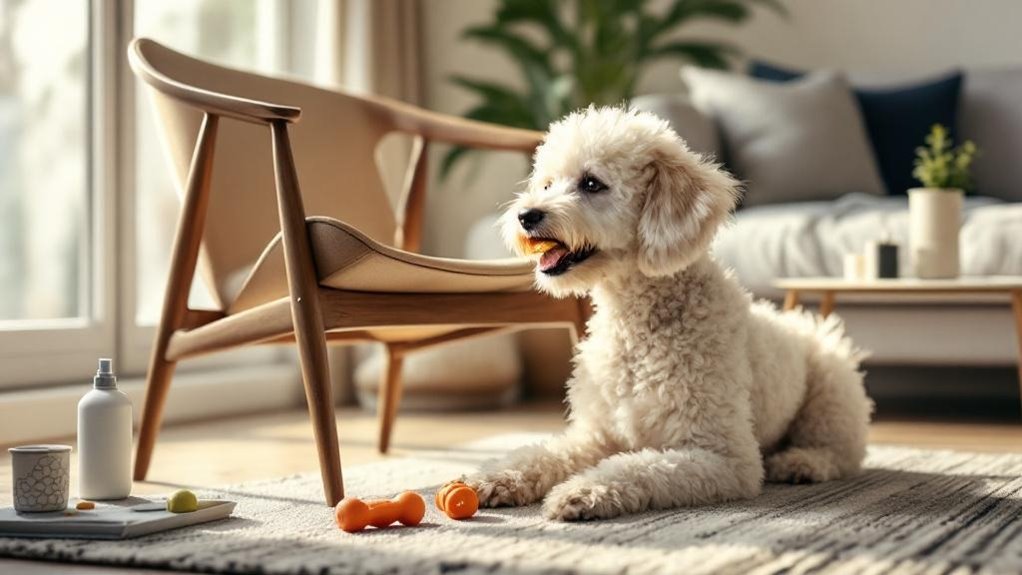
If your poodle keeps chewing furniture, don’t just punish it and hope it stops. You need to find the cause first, then make the habit hard to repeat. Pain, teething, boredom, and anxiety can all play a part. Your setup at home matters too. A few simple changes can stop the damage fast, but one common mistake can make chewing worse.
- Key Takeaways
- Why Is Your Poodle Chewing Furniture?
- Stop Furniture Chewing Right Away
- Check for Pain, Teething, or Anxiety
- Poodle-Proof the House
- Use a Crate or Safe Room
- Give Better Chews and Toys
- Rotate Toys to Prevent Boredom
- Teach Your Poodle What to Chew
- Use Anti-Chew Spray Correctly
- Exercise Before Chewing Starts
- Use Puzzle Toys and Scent Games
- Get Help for Chewing When Alone
- Frequently Asked Questions
- Conclusion
Key Takeaways
- Increase daily exercise and mental enrichment, since bored poodles often chew furniture for stimulation.
- Interrupt chewing calmly, remove access, and immediately redirect to a high-value approved chew toy.
- Puppy teething can cause chewing; offer chilled rubber toys or frozen stuffed KONGs for relief.
- Dog-proof your home and use a crate or chew-safe room with safe chews when unsupervised.
- See a veterinarian if chewing is sudden, severe, or paired with pain, drooling, pacing, or not eating.
Why Is Your Poodle Chewing Furniture?
If your poodle is chewing furniture, the cause is usually simple. Your dog is trying to meet a need, not misbehave. Many poodles chew from boredom. Standard dogs often need more exercise and brain work than smaller types. Without enough activity, chewing starts.
Furniture chewing usually means your poodle needs more exercise, mental stimulation, or both—not punishment.
Age matters too. A young poodle may chew during teething, often from three to eight months. That urge usually eases after adult teeth come in.
Watch when the chewing happens. If it starts when you leave, separation anxiety may be the reason. Whining, pacing, and restless behavior often appear with it.
Sometimes the problem is access and habit. If your dog lacks appropriate chew toys, furniture becomes the target. Pain, hunger, or compulsive chewing can also play a part. A vet can help.
Standard poodles often need longer, more focused training and daily mental stimulation, which can help reduce chewing from boredom.
Stop Furniture Chewing Right Away
Once you know why your poodle is chewing, act fast to stop the habit from growing.
When you catch dog chewing furniture, interrupt with a calm “Uh-oh,” block access, and hand over a high‑value chew. Praise right away when your dog takes it.
Use crate confinement or a chew-proof room whenever you can’t watch closely. Keep safe interactive toys inside, and don’t confine for more than six hours.
Before you leave, give enough exercise and mental stimulation. A brisk walk or hard play session helps. Then offer a food puzzle stuffed with part of dinner.
You can also use bitter sprays on table legs or corners. Spot-test first and reapply daily.
If chewing happens only when alone, ask your vet about separation anxiety and next steps soon.
Tracking triggers and adding more enrichment can also help you prevent chewing before it starts.
Check for Pain, Teething, or Anxiety
Before you treat furniture chewing as a training problem, check for pain, teething, or anxiety. Look for dental pain, red gums, swelling, broken teeth, drooling, or refusal to chew. Sudden chewing furniture can signal injury or illness. If your dog seems lethargic, vocal, or stops eating, call your vet today.
| Sign | What to do |
|---|---|
| Red gums | Book a vet exam |
| Puppies teething | Offer chilled rubber toys |
| Chews alone | Suspect separation anxiety |
| Acts hungry | Feed puzzle meals |
| Sudden severe chewing | Get urgent vet care |
Puppies often chew more during teething, especially before eight months. If chewing starts when you leave, watch for pacing or accidents. That can point to separation anxiety. Ask a trainer or veterinary behaviorist for help. Daily mental and physical stimulation also reduces stress. Puppy potty training routines can also help you spot accident patterns that may point to stress or discomfort.
Poodle-Proof the House
Often, the fastest way to stop furniture chewing is to change what your Poodle can reach.
Often, the quickest way to curb furniture chewing is to limit what your Poodle can access.
First, remove tempting items like shoes, laundry, and kids’ toys. Put them in closed closets or on high shelves. Next, secure electrical cords, blind cords, and other small objects with cord covers and closed trash bins.
Then block off high-risk areas with baby gates. When you can’t watch closely, confine to crate only briefly while you keep the rest of the home dog-proofed.
You can also use pet-safe bitter deterrent sprays on table legs and sofa corners. Spot-test fabric first, then reapply as directed.
Finally, create a chew-friendly zone. Set up one safe spot with a rotation of durable toys and puzzle feeders. Your Poodle will learn what it’s allowed to chew.
Calm greetings and four-paws-on-the-floor rewards can also help teach your Poodle better manners around furniture and people.
Use a Crate or Safe Room
If you can’t watch your Poodle, use a crate or a dog-proofed safe room to prevent chewing and build better habits.
Use gradual crate training so your dog sees the crate as a calm den, not punishment. Before confinement, give 20 to 60 minutes of exercise and a food-filled puzzle toy.
- Choose the space: Pick a crate or safe room with no cords, shoes, laundry, or small objects.
- Set time limits: Puppies and adult dogs shouldn’t stay crated longer than about six hours. Puppies under six months need shorter periods.
- Stock it well: Add several properly sized chew toys and supervise early sessions.
- Watch for problems: If you see separation anxiety, like pacing, whining, urination, or frantic chewing, get help from a qualified behavior professional soon.
Give Better Chews and Toys
Start by giving your Poodle better things to chew than your furniture. Choose durable chew toys that fit your dog’s size and strength. Use size-appropriate chews like a KONG Classic or Benebone, with smaller options for toy and miniature Poodles and larger ones for standards. Always monitor and replace items when they crack or lose pieces.
You can also rotate textures so chewing stays satisfying. Offer firm rubber, nylon, rope, and plush for supervised play. Add food-dispensing puzzles at times your Poodle usually starts chewing. Stuff them with part of your dog’s daily food.
For edible long-lasting chews, use bully sticks or dried beef cheeks and supervise each session. If you have a puppy, frozen washcloths or stuffed frozen KONGs can give teething relief and protect furniture. Keep sessions short and positive, and use a long training leash when you need to redirect your Poodle away from furniture and toward appropriate chews.
Rotate Toys to Prevent Boredom
Good chew toys work better when you don’t leave the same ones out all week. If you rotate toys every 2–3 days, old items feel new again. That novelty helps cut boredom and furniture chew habits.
Rotate chew toys every few days so familiar favorites feel new and keep boredom away from your furniture.
- Keep 6–8 toys in play, with rubber, rope, nylon, and plush options.
- Save favorite toys for a week, then bring them back to refresh interest.
- Use food-based rotation by stuffing a KONG with kibble or frozen wet food.
- Watch which toys hold attention longest, then keep those in your regular cycle.
Poodles often like different textures on different days. A smart rotate plan matches that. If a toy stays ignored, replace it. When you keep choices fresh, your dog stays busy longer and your furniture gets a break at home. Puzzle toys can also turn mealtime into mental enrichment, helping reduce boredom even more.
Teach Your Poodle What to Chew
Show your poodle what they can chew by giving them safe chew toys and taking away the guesswork.
When you catch them mouthing furniture, calmly swap it for an approved chew, then praise them and give a small treat when they use it.
Keep these chews easy to reach, and your poodle will start to learn that toys get rewards and furniture doesn’t.
Poodles also learn faster when you reinforce bite inhibition by rewarding gentle chewing and stopping the game if they get too rough.
Reward Approved Chews
Often, the fastest way to stop furniture chewing is to teach your poodle what’s theirs. Use reward-based learning every time you hand over an approved chew. Say “take it,” then praise and reward when they chew the right item.
- Offer durable choices like KONG Classics, bully sticks, or beef cheek rolls sized for your poodle.
- Supervise chew sessions for 10 to 30 minutes. Remove risky items, avoid cooked bones, and watch for small pieces.
- Pair each approved chew with positive reinforcement. Click, treat, or praise the first several uses.
- Rotate chews every 2 to 3 days. Keep favorites in the bed or crate so they’re easy to find.
Use short play sessions to help your poodle learn which toys and chews are approved.
This builds a strong habit. It also helps you spot unsafe chewing and ask your vet if needed.
Redirect Unwanted Items
Start by setting up a clear swap routine. When your poodle grabs a table leg or cushion, say “Uh-oh,” remove the item, and hand over one of your approved chew toys right away. Praise the switch so chewing the right thing pays off.
Make those choices worth taking. Offer durable chews that fit your poodle’s style, like rubber KONGs, rope toys, or bully sticks. Keep approved chew toys near favorite trouble spots and rotate them every few days. Use pre-loaded puzzle feeders too.
Practice leave it and drop it in short daily sessions. Reward fast releases and calm choices.
When you can’t watch closely, use a dog-proofed room or crate. Stock it with two or three safe chews, including a frozen stuffed KONG, so furniture isn’t an option.
Use Anti-Chew Spray Correctly
Use a pet-safe anti-chew spray the right way so it helps instead of causing new problems.
Test it on a hidden spot first, apply it to the target areas and reapply as needed, then let it dry fully before your poodle gets near it.
Don’t rely on spray alone; when you catch your poodle chewing, redirect them to a chew toy and reward that choice.
Apply And Reapply
Always test the anti-chew spray on a hidden spot first, like the underside or a back corner, so you can check for discoloration or finish damage before you treat the whole area.
Then test on inconspicuous area again if needed and apply the deterrent evenly wherever your poodle can reach.
- Cover legs, edges, and corners with anti-chew spray.
- Allow to dry fully and keep your dog away.
- Reapply daily for 2–4 weeks.
- Reapply after cleaning or rain.
If your poodle still investigates, offer a supervised lick from a tissue with the spray, not the furniture. That helps connect the bad taste to the item.
After that, remove access and redirect to approved toy right away. Stay consistent. Sprays work best when you keep the taste and smell strong every day.
Pair With Redirection
For best results, pair the spray with quick redirection every time your poodle checks the furniture.
Clean the spot first, test the deterrent on a hidden area, and let it dry fully so the taste stays consistent. Then watch closely. If your poodle sniffs or mouths the furniture, calmly say “Uh-oh,” move them away, and offer chew toys or a food puzzle within one to two seconds.
Keep this practice supervised and repeat it each time. Rotate two strong options, one durable and one edible, so your dog learns what to chew instead. Use positive reinforcement right away. Praise, then give a small treat when your poodle uses the toy. If your dog guards items or acts aggressive, stop and contact a Certified Professional Dog Trainer promptly.
Safe Deterrent Use
Anti-chew spray works best when you apply it carefully and keep the setup safe. Use deterrent sprays as one tool, not the whole plan.
- First, test on inconspicuous area. Try a commercial bitterant or a weak mix of apple cider vinegar and water. Check for stains before wider use.
- Let your poodle smell a tiny dab on tissue. Then spray only the target surface, not your dog or toys.
- Reapply daily and after cleaning or heavy chewing. Most scents fade fast, so the reminder won’t last long.
- Avoid caustic formulas like cayenne or harsh cleaners. Pair sprays with supervision and confinement when needed, plus positive training. Teach leave it, reward chew toys, and ask your vet first if skin is sensitive or your dog has health issues.
Exercise Before Chewing Starts
Often, a tired poodle is far less likely to chew your furniture when you leave. Give your dog 20 to 30 minutes of exercise before alone time. A brisk walk, fetch, or recall game helps drain extra energy.
If your poodle is high-drive, add 10 to 15 minutes of chase or tug right before confinement. That extra burst works well for active standards and miniatures.
You should also include physical and mental work. Spend 10 to 20 minutes on obedience, tricks, or short scent tasks. This helps your dog settle faster.
Try to finish the last activity 15 to 30 minutes before you go. Then offer a safe chew or food puzzle. If separation anxiety or long absences add stress, arrange a walker or mid-day play break.
Use Puzzle Toys and Scent Games
Once your poodle has burned off some energy, give that chewing urge a better job.
Use puzzle toys and scent games to redirect chewing and reduce boredom. Try this:
- Freeze Kong with kibble, canned food, and a little pumpkin or unsalted peanut butter for 2 to 4 hours.
- Offer food-dispensing toys when chewing usually starts. Begin with 5 to 10 minutes, then build to 20 to 30.
- Rotate 3 or 4 toys each week, including a snuffle mat, scatter feeding, or muffin tin hide-and-seek.
- Set up short foraging sessions by hiding kibble in one safe room.
Supervise at first so you can see what holds your poodle’s interest. Use part of the daily meal in these activities, about 25 to 50 percent, to keep calories in check.
Get Help for Chewing When Alone
If your poodle chews furniture mostly when you’re gone and also whines, paces, or has accidents, you should suspect separation anxiety.
Start with calm exits and returns, short practice absences, and a puzzle feeder or frozen KONG when you leave, and only use a crate or small room if your dog stays calm there.
Record what happens on video, then ask your vet or a certified behavior specialist for a treatment plan and medical advice if the chewing is severe.
Separation Anxiety Signs
Sometimes furniture chewing isn’t a boredom problem at all. If your Poodle shows destructive chewing behavior only when alone, watch for separation anxiety. Common clues include whining, barking, pacing, drooling, and house-soiling soon after you leave.
Look for these signs:
- Chewing starts within minutes of departure, not later.
- The damage happens despite enough exercise and enrichment.
- Video shows panic patterns you can share with your vet or trainer.
- Crating doesn’t help, or it makes distress worse.
These patterns point to panic, not mischief. If symptoms keep happening, ask about behavior modification and whether medication may help. If your dog growls, lunges, or guards chewed items, stop trying to take them away. Contact a certified trainer or a veterinary behaviorist right away.
Alone-Time Management
Planning ahead helps most Poodles stay calm and keeps your furniture safer when you leave. Give your dog 20 to 40 minutes of exercise first. A brisk walk, fetch, or play session lowers arousal and boredom.
Then use a crate or small dog-proofed room. Remove shoes, cords, trash, and other tempting items. Add food-dispensing puzzle toys with part of your poodle’s kibble or a frozen Kong. Rotate chew options so your dog has two or three safe, durable choices. For teething, offer a frozen wet washcloth too.
Keep alone time to six hours or less. You can also use a pet-safe bitter spray on furniture legs.
If chewing happens only when you leave and comes with whining, pacing, or accidents, separation anxiety may be involved.
Professional Support Options
Start with your veterinarian when your Poodle chews furniture while you’re gone. Ask them to consult veterinary causes like pain, dental disease, or hunger. They can also guide treatment and discuss anxiolytic medication when needed.
- If you see pacing, whining, urination, or panic, suspect separation anxiety. You need a behaviourist, ideally a Dip ACVB or CAAB.
- If chewing is intense, repetitive, or fabric-sucking, find a behaviourist or a CPDT with compulsive case experience.
- A CPDT can teach desensitization, crate training, and simple replacement habits like chewing a toy instead of furniture.
- If your dog guards chewed items, acts aggressively, or destroys things badly, get professional help now. Don’t try DIY fixes.
These experts build a safe plan and work together for better results.
Frequently Asked Questions
What Can I Do to Make My Dog Stop Chewing on My Furniture?
Give your dog more exercise, redirect chewing to durable toys, and dog-proof furniture access. You can offer frozen chews for teething, use calm trades and praise, and ask your vet about anxiety if it persists.
What Is a Dog Lacking When They Chew on Wood?
Your dog’s usually lacking dental relief, mental stimulation, physical exercise, suitable chew options, or emotional security. You should offer teething-safe chews, enrichment toys, daily activity, and assess stress or separation anxiety if wood-chewing continues.
How Do You Discipline a Dog for Chewing on Furniture?
You don’t punish furniture chewing after the fact; instead, catch it happening, interrupt calmly, remove the item, and redirect your dog to a valued chew. Praise the swap, manage access, and seek professional help if guarding appears.
What Repels Dogs From Chewing Furniture?
You can repel chewing with bitter commercial sprays, diluted vinegar or lemon spray, and cautiously used cayenne solutions. Reapply often, spot-test surfaces, redirect instantly to a chew toy, and don’t skip exercise, confinement, or training.
Conclusion
Start with the cause, then change what your poodle can reach. Redirect fast and offer a safe chew every time. Use a crate or dog-proof room when you can’t watch. Add exercise, puzzle toys, and scent games before quiet hours. Test bitter spray first and use it the right way. If chewing happens when your dog is alone, get professional help. An ounce of prevention is worth a pound of cure.