
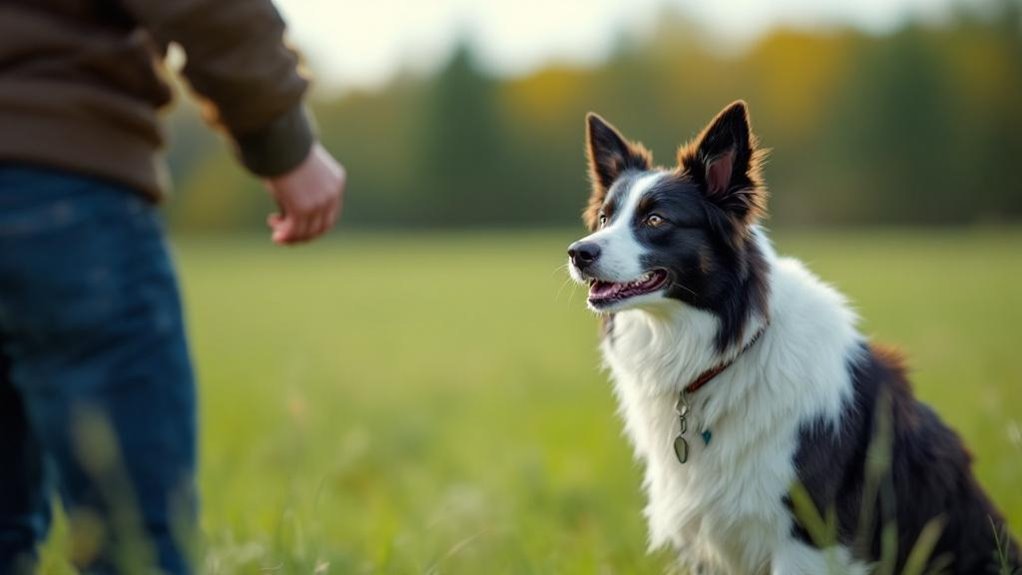
Off-leash training works best when you treat it like a series of small steps, not one big test. You start in a safe fenced space, build a strong recall with rewards your Border Collie truly wants, then add distance, a long line, and mild distractions one at a time. If you rush, you lose trust and control. If you pace it well, you set up real freedom later—and the next step matters most.
- Key Takeaways
- Check if Your Border Collie Is Ready
- Build Recall in a Fenced Area
- Use High-Value Rewards for Recall
- Teach the Off-Leash Commands That Matter
- Add a Long Line for Safe Freedom
- Practice Check-Ins During Long-Line Walks
- Stop Chasing Before Off-Leash Work
- Add Distractions Without Losing Recall
- Train Around Cars, Bikes, and Wildlife
- Know Leash Laws and Off-Leash Risks
- Try Off-Leash Practice in Secure Spaces
- Graduate to Parks and Trails Slowly
- Handle Regressions Without Starting Over
- If Your Dog Runs, Do This
- Frequently Asked Questions
- Conclusion
Key Takeaways
- Start in a quiet fenced area using a secure harness and 20–30 foot long line; reward every recall with high-value treats or play.
- Build reliability first: aim for 90% recall success at 20–30 feet and solid Sit, Stay, Look, Drop It, and Leave It.
- Teach check-ins by rewarding eye contact every 30–60 seconds, and use a fast marker like “Yes!” the moment your dog returns.
- Increase distance and distractions gradually, adding only one mild challenge at a time and regressing if success drops below 80%.
- Unclip only when health, ID, microchip, and legal requirements are covered, and never start near roads or heavy bike traffic.
Check if Your Border Collie Is Ready
Start by testing your Border Collie in a fenced backyard with a 30-foot long line. You want a reliable response at least 9 out of 10 times before you consider more freedom.
Test recall in a fenced yard with a 30-foot line and aim for 9 out of 10 reliable responses.
Next, check basic obedience. Your dog should hold Sit, Stay, Look, Drop It, and Leave It during mild distractions. Practice 10 minutes a day for several weeks and watch for steady results.
Then test impulse control. Use distance around other dogs, sheep, or bicycles. If your dog breaks recall more than once in three trials, your dog isn’t ready.
Also confirm health and safety basics. Vaccinations should be current. Your dog needs an ID tag, microchip, and parasite prevention. Avoid off-leash time for intact dogs during mating season. Watch for calm focus after play too.
Recall training and early socialization can make this readiness test more reliable.
Build Recall in a Fenced Area
Start in a secure fenced area and call your Border Collie from just a few feet away.
Reward every return with a small soft treat, praise, or a quick game so your dog learns that coming back pays off.
Then add mild distractions and slowly increase the distance only when your dog comes back every time.
Keep the cue upbeat and avoid poisoned cues by never using recall to end fun or start something unpleasant.
Start With Short Recalls
Always begin recall work in a secure fenced yard so your Border Collie can’t bolt if prey or herding instincts kick in. Keep sessions short, about 5 to 10 minutes, two or three times a day.
Start at 3 to 10 meters. Use one cue, like “Come,” once. Say it in a bright voice so your dog wants to come back. If your dog ignores you, don’t chase. Reset and make it easier.
Border Collies also need mental stimulation to stay focused and avoid boredom during training.
| Step | What you do | Goal |
|---|---|---|
| 1 | Start close | Fast response |
| 2 | Use one cue | Clear pattern |
| 3 | Add small distance | Build success |
After 8 to 10 solid recalls, add 5 to 10 meters or one mild distraction, like a toy off to the side. End on a win always.
Reward Every Return
In a secure fenced area, reward every return the moment your Border Collie reaches you. Use high-value treats like cooked chicken or cheese so coming back pays well. Keep your timing fast. Mark the return, then give the reward right away.
Keep sessions short, about 5 to 10 minutes, and practice several times each day. End while your dog still wants more. Start at 3 to 5 meters, then slowly work up to the full yard. Reward every return at every distance so distance never changes the outcome.
Mix in praise, a favorite toy, and occasional jackpot rewards. If your dog doesn’t come, don’t punish or chase. Use a long line for a calm retrieval. Then reward every return heavily to rebuild trust and keep recall strong. Clicker training can help you mark the exact moment your dog returns, making the reward message even clearer.
Add Mild Distractions
Next, add one mild distraction at a time in a secure fenced yard with a 20 to 30 foot long line dragging behind your Border Collie. Use a fence at least 6 feet tall. This setup gives freedom and still blocks escapes.
- Start with one trigger, like a still jogger, a distant bike, or a squeaky toy 20 to 30 meters away.
- Give your recall cue in a bright, steady voice, then reward every return with high-value treats or a favorite toy.
- Keep practice to 5 to 10 minutes, 2 to 3 times a day, and wait for 8 to 10 good recalls before making it harder.
Border Collies have strong prey drive. If success drops below 80 percent, lower the distraction and go back. Impulse control helps your dog stay focused and improves reliability around distractions.
Use High-Value Rewards for Recall
Often, your Border Collie will ignore a basic treat when something more exciting grabs their focus, so use truly high-value rewards for recall, like tiny pieces of cooked chickened hot dog, or freeze-dried liver.
Give these high-value treats the moment your dog reaches you. Add a clear marker like “Yes!” or a click within one second, then praise with energy. Fast timing helps your dog connect coming back with a strong payoff.
Keep each piece very small, about pea to nickel size. That lets you practice many recalls in a short 10 to 15 minute session without overfeeding.
Save the best rewards for off-leash recalls or hard moments around distractions. Use lower-value food for easier work. Then vary the payoff. Sometimes give one treat, sometimes several, or food plus play.
Border Collies also do best with mental stimulation and plenty of exercise, so pairing recall practice with daily activity can help reduce boredom and improve focus.
Teach the Off-Leash Commands That Matter
Focus on the off-leash commands that keep your Border Collie safe and connected to you off leash. Start with recall. Practice every day in a secure fenced area. Begin close, then build distance to 20 to 30 feet. Always reward returns with treats, praise, or play.
- Teach “Look” with one clear cue and reward each glance at you.
- Train fast “Sit” and “Down” so you can stop movement at a distance.
- Use voice, hand signals, and a whistle for recall and stop cues.
Keep your standards clear. Your dog should check in within one to two seconds when you cue “Look,” even with mild distractions. For stop commands, build speed and consistency first. Then add harder distractions. Reward every success, because coming back to you must beat chasing motion every time.
Try adding nose work games indoors on rest days to keep your Border Collie mentally engaged and reduce boredom.
Add a Long Line for Safe Freedom
Clip on a 20 to 30 foot long line and attach it to a secure harness, not just a collar, so your Border Collie can move with some freedom while you still keep control.
Start in a quiet, familiar space. Let the long line drag as you practice recall, Heel, and Look. Your dog gets freedom cues, but you can still step in if distraction pulls focus.
Keep each session short, about 8 to 10 minutes, and train often. Use high-value treats. A crinkled treat bag can help catch your dog’s attention from farther away.
Reel the long line in and out at times. This teaches distance awareness and supports a clean return from 15 to 30 feet.
Before you unclip it, get several strong recalls over multiple days. Check the harness and clips every session.
Practice Check-Ins During Long-Line Walks
You should reward every time your Border Collie checks in on their own, because that makes staying connected to you more valuable than any distraction.
Start with short distances on the long line, then slowly add more space and new angles as your dog succeeds.
If your dog misses a check-in, shorten the line, cue again, and pay well when they respond.
Use calm zones to help them settle between practice sessions.
Reward Voluntary Check-Ins
Often, the best time to build check-ins is during long-line walks with 20 to 30 feet of freedom. When your Border Collie offers a check-in, mark it at once with a clicker or short cue, then reward within one second.
- Use high-value treats, praise, or a quick play burst.
- Aim for a check-in every 30 to 60 seconds at first.
- Give a jackpot now and then for fast or distant returns.
This teaches your dog that looking back or moving toward you pays well.
Keep rewards varied so your dog stays engaged while exploring.
If your dog stops offering check-ins, shorten the line and work closer. Catch the behavior again, mark it clearly, and pay well. Then let your dog explore with attention and confidence.
Build Distance Gradually
As your Border Collie gets better at checking in, start building distance in small steps on a 20 to 30 foot long line attached to a secure harness.
During leash training, let your dog roam for 5 to 10 minutes, then call them back every 15 to 30 seconds. Reward each return with praise or small pieces of chicken or cheese. You can also use a rustling treat bag sound to signal a quick payoff.
Start at 10 to 15 feet and aim for 10 to 15 check-ins each session. Only increase distance when your dog succeeds at least 90 percent of the time. Over time, work toward 50 to 75 feet.
Add one mild distraction at a time. Keep the line ready. End after one strong check-in with a big reward and play.
Stop Chasing Before Off-Leash Work
Stop chasing before any off-leash work starts. Your Border Collie needs impulse control before freedom. Start curbside with “Leave It” and “Look” in quiet places. Aim for 90% success. Use high-value treats and reward every correct response before you add moving targets.
- Practice recalls on a 20–30 foot long line in parking lots and low-traffic areas. Never unclip near roads.
- Use a mat to teach calm. Let bikes or skates pass at a distance, then move closer only when your dog stays relaxed.
- Replace chasing with better jobs. Reward instant recalls, play hide-and-seek, and use simple control games.
If your dog still chases after steady practice, pause off-leash plans. Get help from a professional trainer. Some Border Collies need more structure and repetition.
Add Distractions Without Losing Recall
Once your Border Collie recalls well in quiet places, add distractions in small steps so you don’t lose that response.
Once recall is solid in calm settings, add distractions gradually to protect your Border Collie’s response.
Start in your yard, then move to a wooded area, then a park with distant walkers. Use a 20 to 30 foot long line until recalls stay at least 90 percent reliable.
Keep distraction training controlled and predictable.
Ask a friend to walk by, place a jogger far away, or work near one calm dog on leash. Reward every recall with tiny chicken or cheese, then mix in toys and praise. Make coming back worth more than the distraction.
Train for 5 to 10 minutes, a few times each day.
Practice while you stand still and while you move. If your dog misses, lower difficulty, reset distance, and rebuild.
Train Around Cars, Bikes, and Wildlife
Before you work near cars, bikes, or wildlife, make sure your Border Collie already has a very strong recall in a fenced area. Aim for 90% success from 20 to 30 feet, even with distractions around.
- Use a 20 to 30 foot long line and harness. Start by sitting and watching passing cars or bikes from a safe distance.
- Teach an emergency cue, like a whistle and “Come.” Reward fast responses with high-value treats and practice with traffic or bike sounds.
- Train “Leave it” and “Look” for wildlife. Reward quick attention shifts and avoid wildlife-heavy places at dawn or dusk.
If your Border Collie bolts, don’t chase or punish. Turn away, rustle treats, or use your emergency recall. Progress only after several calm, supervised sessions.
Know Leash Laws and Off-Leash Risks
Even if your Border Collie responds well in training, you still need to know your local and state leash laws and respect the real risks of off-leash time.
Many places require an off-leash dog to stay under control, or they limit leash length. If you ignore those rules, you can face fines.
Risk matters too. Border Collies move fast and react fast. They may bolt, chase wildlife, run into traffic, fight with another dog, or swallow something toxic.
Before you allow more freedom, make sure your dog has a microchip and ID tag. Keep vaccines and parasite prevention current. Spaying or neutering can also reduce roaming.
A GPS tracker helps if your dog slips away. Real-time location, geofencing, and escape alerts can save time when seconds matter most.
Try Off-Leash Practice in Secure Spaces
Start your off-leash practice in a fully fenced yard or agility run with fencing at least 6 to 8 feet high. This lets your Border Collie work at distance without escape risk. Begin with a 20 to 30 foot long line so you can guide your dog to go back to you and reward fast returns.
- Keep recall and check-in drills short, about 5 to 10 minutes.
- Use high-value treats or a favorite toy every time your dog returns.
- Add one mild distraction only after several clean sessions.
You should practice several rounds each session. Keep the space calm at first. Then add one walker or one dog at 20 to 30 yards.
Before you drop the long line, make sure recalls are 90% reliable over several days. Check ID, vaccines, and microchip too.
Graduate to Parks and Trails Slowly
With that foundation in place, move to parks and trails in small steps. First, proof recall in a fenced area until your Border Collie returns from 30 feet with distractions. Then start getting your dog used to quiet park edges on a 20 to 30 foot long line.
| Setting | Goal |
|---|---|
| Quiet park edge | Fast recall |
| Calm trail turn | Check-ins |
Keep sessions short, about 10 to 15 minutes, and go during low-use hours. Add distance and distraction only after several clean recalls. Reward focus with great treats and your “Look” cue when bikes, horses, or wildlife scents appear in controlled setups. Wait on busier times until your dog ignores joggers, cyclists, and other dogs. If chasing, herding, or car focus shows up, keep long-line work and practice emergency Sit and Recall.
Handle Regressions Without Starting Over
When your Border Collie hits a rough patch, don’t scrap the plan. Regression is normal in dog training, especially from 6 to 18 months. Tighten the setup instead. Shorten distance and go back to a long line for several 10-minute sessions each day until recall feels steady again.
Regression is normal, especially in adolescence. Don’t quit the plan—tighten the setup, shorten distance, and rebuild recall on a long line.
- Use better rewards like tiny high-value treats or tug.
- Ask for recall every 2–5 minutes during off-leash practice.
- Give play or freedom only after recall or Sit.
Before off-leash time, do 15–20 minutes of scent games or short obedience work. That helps lower trigger focus and improve engagement.
Keep score too. Track success over 20 recall attempts. If you’re at 60 percent, don’t add distance or distractions yet. Build back to 90 percent first. Then progress again.
If Your Dog Runs, Do This
If your Border Collie runs, stay calm and don’t chase. Turn away, call them back in a firm, even voice, and show a high-value treat to give them a reason to return. If there’s danger ahead, use your emergency cue at once and move to block the hazard without panic.
Stay Calm, Call Back
First, stay still and get calm fast. If your Border Collie bolts, don’t chase. Turn your body away and call your dog’s name in a calm, even voice. Border Collies notice motion, so you need to stay calm and reduce pressure.
- Use your emergency recall cue, one short word your dog knows well.
- Kneel or squat, rustle the treat bag, and look easy to approach.
- If needed, walk slowly away and use your recall whistle at intervals.
When your dog returns, mark the moment with happy praise and a jackpot reward. That builds a stronger habit next time.
If your dog disappears from view or the area is unfamiliar, switch on your GPS tracker’s Live mode. Check the heat-map history and keep calling from the last known spot with treats ready nearby.
Use Treats, Don’t Chase
Often, the fastest way to get your Border Collie back is to stop moving, turn away, and use treats instead of chasing.
If you chase, you can trigger play or prey drive, like playing fetch, and your recall may fail. Call your dog’s name in a calm, upbeat voice. Rustle a visible treat bag or use a whistle. Make the reward obvious and immediate.
Use small pieces of chicken or cheese. If your dog hesitates, drop treats on the ground while you back away slowly. Keep calling and let curiosity pull your dog toward you. You can also turn and walk briskly away.
Practice this before going fully off leash. Use a 20 to 30 foot long line in open or wooded areas. Reward every return. Build success at short distance first.
Frequently Asked Questions
Are Border Collies Easy to Train off Leash?
Yes, you can train Border Collies off leash relatively easily, but you’ll need consistency. Their intelligence helps, yet strong herding instincts and distractions complicate recall, especially during adolescence, so keep practicing daily with high-value rewards.
What Is the 10-10-10 Rule for Puppies?
The 10-10-10 rule means you give your puppy 10 minutes of training, 10 minutes of exercise, and 10 minutes of calm enrichment per session. You’ll repeat it daily to build skills safely without overdoing attention.
What Is the Leading Cause of Death in Border Collies?
The leading cause of death in Border Collies is usually trauma, especially road accidents and off-leash injuries. You can reduce that risk with solid recall training, secure fencing, long lines, and GPS trackers during exercise.
What to Do if Your Puppy Sits and Refuses to Budge on a Walk?
Pause, stay calm, and don’t drag your puppy. Lure one step with a high-value treat and “Come.” Turn away, call cheerfully, reward tiny movement, and retreat to a quieter area if they’re overwhelmed.
Conclusion
Off-leash freedom looks easy, but you earn it with steady practice. You start in small, safe spaces. Later, you test bigger places with more distractions. Fast progress can feel good, but slow progress keeps your dog safe. If recall slips, you don’t quit. You tighten the basics and build again. Keep rewards strong. Keep sessions short. Stay patient and clear. In the end, real freedom isn’t less control. It’s trust, proof, and good habits that hold up anywhere.