
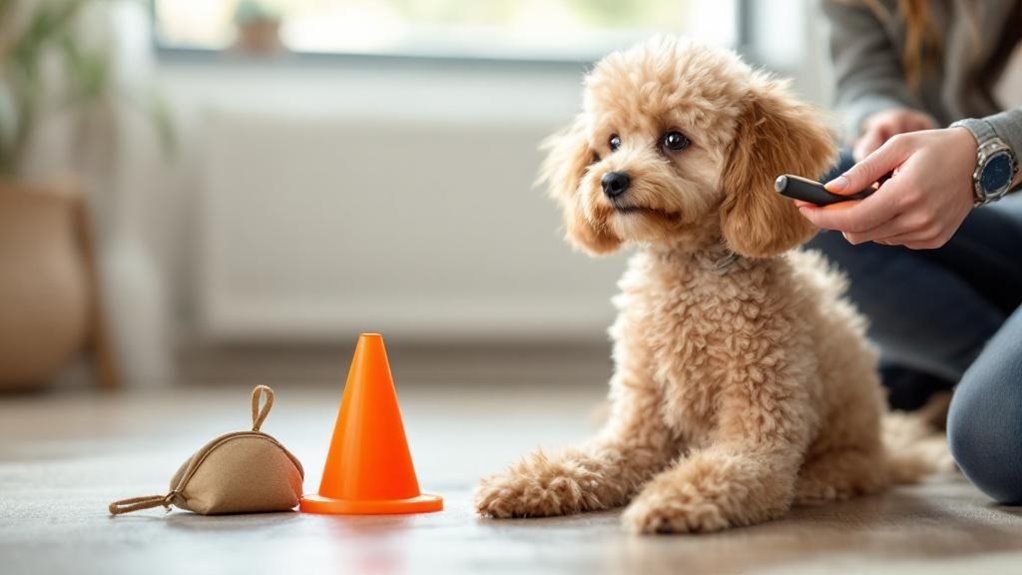
If your Toy Poodle sits at home but ignores “sit” outside and barks at every sound, you’re facing a common training problem. You can fix it, but you need clear cues, fast rewards, and a steady routine. Short sessions work better than long ones, and calm comes before obedience. Small mistakes in timing can stall progress, which is where most owners get stuck.
- Key Takeaways
- Understand Why Toy Poodle Training Is Hard
- Use Reward Timing and Clear Cues
- Build a Daily Training Routine
- Keep Sessions Short and Successful
- Teach Calm Before Obedience
- Socialize Your Toy Poodle Without Overwhelm
- Stop Barking and Nipping Early
- Help Your Toy Poodle Focus and Listen
- Ease Separation Anxiety Gradually
- Simplify Potty and Crate Training
- Know When to Call a Trainer
- Frequently Asked Questions
- Conclusion
Key Takeaways
- Keep training short and consistent: 5–10 minutes once or twice daily, using one cue per skill and ending on success.
- Use a clicker or “yes” marker and reward within 1–2 seconds to teach fast-learning Toy Poodles with clear timing.
- Prevent barking, jumping, and attention-seeking by rewarding calm behavior, four paws on the floor, and brief quiet pauses.
- Manage nipping, separation, and potty issues with structured routines, crate training, frequent potty trips, and gradual alone-time practice.
- Build focus with exercise first, quiet-room practice, mental games, and slow exposure to people, dogs, sounds, and new places.
Understand Why Toy Poodle Training Is Hard
Training a Toy Poodle can feel harder than you expect because they learn fast, notice every mixed signal, and repeat whatever works for them. Toy Poodles read your habits closely. If rules change, they learn loopholes instead of reliable behavior.
Toy Poodles learn quickly, spot inconsistency faster, and turn mixed signals into habits that are hard to undo.
Their size also changes how you treat them. Because they’re a small dog, you may carry them, excuse barking, or allow jumping. That creates pushy habits and weak boundaries unless you use consistent training every day.
Anxiety makes training harder too. Toy Poodles often struggle with separation anxiety, so being alone can trigger barking, accidents, and clingy behavior.
Boredom matters just as much. Without daily mental stimulation, they lose focus fast and invent their own fun. Then you see chewing, noise, and selective listening. Calm structure helps them learn and stay steady.
Use Reward Timing and Clear Cues
Start with timing. Your Toy Poodle needs the reward within one to two seconds of the right action. Strong reward timing builds a clear link between the cue and the behavior. Add a marking signal like a click or a quick “yes” at the exact moment your dog gets it right, then give the reward.
Use one consistent cue for each skill, such as “sit” or “come.” Don’t change words or add extra chatter. Your dog notices those shifts. Keep rewards valuable at first, using food, praise, or a toy. When responses stay reliable, fade to intermittent rewards.
If your dog stalls, help gently and reward small steps forward. That’s how successive approximations work. Use short sessions with just a few reps to keep focus strong and progress steady. short sessions also help Toy Poodles manage their energy and stay attentive.
Build a Daily Training Routine
Set your Toy Poodle’s training at the same times each day so your dog knows what to expect.
Keep each session short, and pair practice with a brisk walk or play time so your dog can focus better.
You’ll make steadier progress when you train for a few minutes, stay consistent, and stop before your dog gets tired.
Use four-paws-on-the-floor rewards and calm greetings to help curb jumping during daily practice.
Set Consistent Training Times
Often, your Toy Poodle will learn faster when you hold two short sessions each day at the same times.
Poodles respond best when you Schedule two short training sessions daily, about 5 to 10 minutes each.
Keep sessions short so your dog stays focused and keen.
Use a consistent routine.
Try mid-morning when your dog is alert, then late afternoon after a potty break, walk, or meal.
This training helps your Toy Poodle expect practice and feel less anxious, even at 8 weeks old.
Limit each skill to 5 to 10 repetitions.
Stop while your dog is doing well.
Ending on success keeps interest high for the next session.
Write each session in a simple log.
Note the time, length, skills, and wins.
You’ll spot patterns and improve timing.
Short training sessions also fit your puppy’s limited focus and help keep learning positive.
Balance Exercise And Practice
Building a daily routine helps your Toy Poodle stay calm, focused, and ready to learn.
Pair training with both physical exercise and mental exercise each day. Start with a brisk 10 to 15 minute walk, then do one of your short training sessions. Later, choose another time when your Toy Poodle is naturally alert for more training.
Keep the day predictable with potty, play, training, and rest blocks.
Add 20 to 30 minutes of mental exercise through puzzle feeders, scent games, or trick practice. Change the place and rewards during the week, but keep your cues the same. That helps your dog use skills anywhere.
Watch for stress or fading attention. End early if needed. Aim for a few clear, successful repetitions, and stop while your dog is still doing well. A calm zone can also help your Toy Poodle settle between training sessions.
Keep Sessions Short
Usually, Toy Poodles learn best in short sessions, so keep training to 5 to 10 minutes twice a day. Your Toy Poodle will lose focus if you push too long.
Plan training sessions when your dog is alert, not right after a big meal or hard play.
Keep each skill to 5–10 repetitions. That helps prevent boredom and keeps responses sharp.
Start in a quiet room with few distractions. When your Toy Poodle does well in short sessions, practice in busier places.
Watch your dog closely. If your Toy Poodle still seems engaged and successful, end the session there. Don’t wait until mistakes pile up.
Stopping early builds confidence and makes the next session easier. Short sessions done often teach more than one long practice. Aim for steady progress every day.
Track barking triggers so you can spot what sets your Poodle off and make training more effective.
Keep Sessions Short and Successful
Keep each training session to 5 to 10 minutes, once or twice a day, so your Toy Poodle can stay focused and learn well.
Give only a few repetitions for each skill and stop while your dog is still engaged, so you end on a success.
Reward the right response right away, and if your dog starts to lose focus, switch skills or try again later.
Use high-value treats to make recall more rewarding and help your poodle respond with enthusiasm.
Short Daily Sessions
Training works best in short bursts with a Toy Poodle, so aim for 5 to 10 minutes once or twice a day. Toy Poodles do best with short sessions because their focus fades fast during long drills. Keep each exercise to 5 to 10 repetitions, then pause before your dog gets bored or starts making up other behaviors.
Use clear reward timing. Give high-value treats or praise within 1 to 2 seconds of the right response so your Toy Poodle connects the action to the reward.
Watch your dog’s focus. If you see wandering, sniffing, or repeated mistakes, stop and try again later. Pick times when your dog feels alert, like after a short walk or play. Avoid training right after a big meal or when your dog is tired.
Toy Poodles often learn quickly when sessions also include mental stimulation and positive reinforcement.
End On Success
Because Toy Poodles learn best before they wear out, end each session in 5 to 10 minutes while your dog is still engaged.
Use short sessions and keep each exercise to about 5 to 10 repetitions. Stop once your dog responds well, not after mistakes pile up.
Your goal is to finish on success. If focus drops or errors rise, lower the difficulty, raise the reward, and ask for an easy cue like sit or touch.
That helps protect your dog’s confidence and keeps the last result clear and correct.
Try to keep a success rate near 80 to 90 percent. That level supports learning without strain.
Use positive reinforcement at the end, with warm praise or a favorite toy. Train twice daily if you can.
Clicker training can also help Toy Poodles learn faster by marking the exact moment they do the right thing.
Teach Calm Before Obedience
Settling first sets the tone for everything that follows. Teach your Toy Poodle to settle before obedience work, play, petting, or food. Keep this calm training short, just 3 to 5 minutes, two or three times during daily training. Start after a brisk walk or play so your dog is ready to focus.
Use a low, neutral cue like “settle” or “mat.” Reward any calm lying down within one or two seconds. Build impulse control by adding time slowly, from five seconds to several minutes.
Practice on a mat in the living room, by the front door, and in the car. Add distractions in small steps. Don’t rely on treats alone. Pair rewards with quiet praise, gentle petting, or access to a favorite activity after your dog settles well first.
Socialize Your Toy Poodle Without Overwhelm
Start your Toy Poodle’s social time at 8 to 12 weeks with one calm person or dog at a time.
Keep each meeting short and easy, and use treats, praise, or a favorite toy so your poodle links new things with good feelings.
Add a little more time only when your dog stays loose and relaxed, and stop before stress shows.
Start Small And Calm
When your Toy Poodle is about 8 to 10 weeks old, keep social time short and calm so your puppy can take in new people, sounds, and surfaces without stress.
Start small with socialization. Use short exposures of 3 to 5 minutes. Show only one or two new things each outing. Stop while your puppy still seems curious.
Use a calm tone and soft movements. Reward relaxed behavior right away with praise or a tiny treat. That quick timing helps your puppy connect calm actions with good results.
Add daily handling exercises for 1 to 2 minutes. Gently touch ears, paws, and mouth. This lowers stress for grooming and vet care.
Later, you can slowly add more time, car rides, or brief walks once your puppy stays relaxed in earlier sessions.
Build Positive Social Skills
Often, your Toy Poodle will build better social skills with short and positive practice than with long or busy outings.
Start socialization at 8 to 16 weeks.
Use short exposures of 5 to 10 minutes.
Add time slowly so your puppy stays confident.
Choose calm adult dogs for early playdates.
Keep introductions to one or two dogs.
Stop if you see hiding, snapping, or avoidance.
Use positive reward-based methods.
Praise and give tiny treats within one or two seconds for calm greetings and loose body language.
Skip crowded dog parks for now.
Wait until your puppy walks well on leash and knows sit, come, and stay.
- Vary people, places, sounds, and surfaces.
- Include car rides and groomer visits.
- Keep sessions predictable and brief.
- Practice across settings to reduce one-person bonding.
Stop Barking and Nipping Early
Early habits stick, so teach your Toy Poodle that calm behavior gets rewards and barking or nipping doesn’t.
Early habits last, so reward your Toy Poodle’s calm behavior and never reinforce barking or nipping.
To stop barking, wait for one brief pause, then mark it within one or two seconds with praise and a treat. Add the cue “Quiet,” then slowly ask for longer silence.
For nipping, end play the moment teeth touch skin. Offer a chew toy, then restart play only after a few seconds of gentle mouthing. That builds bite inhibition.
Don’t reward noisy or mouthy bids for attention. Look away, stay still, and avoid touching. When your Toy Poodle stays calm, reward that.
Use short training and mental-stimulation sessions twice a day. Add brisk exercise first. Also teach sit or settle for greetings to prevent excited yaps and nips.
Help Your Toy Poodle Focus and Listen
Usually, your Toy Poodle will focus better if you keep training short and clear. Use short sessions of 5 to 10 minutes once or twice a day. Repeat each skill a few times, then stop before your dog fades.
Start where you can reduce distraction, like a quiet room. Wait until your Toy Poodle gets a cue right 80 to 90 percent of the time indoors before you practice outside.
- Try pre-exercise with a brisk walk or play first.
- Use high-value rewards fast, within one or two seconds.
- Mix treats, praise, and play so listening stays strong.
- Fade food slowly, but keep cues and rules consistent.
Don’t let treats become bribes. You want your dog to respond because the cue matters, not only because food appears nearby.
Ease Separation Anxiety Gradually
Your Toy Poodle also needs to learn that being alone is safe. Start desensitization at 8 to 10 weeks with very short absences, just 30 to 60 seconds. Increase duration slowly, only 10 to 20 percent each day, so you build tolerance without triggering separation anxiety.
Use a calm settle routine too. Practice on a mat for 5 to 10 minutes several times a day. Add light distractions and longer stays so your dog learns to relax on its own.
Keep your schedule predictable. Plan play, training, and alone time in a steady order. Start alone time after 15 to 20 minutes of exercise.
Pair departures with low-value cues like picking up keys. If severe small-breed distress appears, contact your vet or a certified behaviorist right away.
Simplify Potty and Crate Training
Often, potty and crate training work best when you keep the day simple and steady.
Start potty training when your poodle puppy is 8 to 12 weeks old. Take your Toy Poodle outside every 1 to 2 hours and right after meals, naps, or play. Praise within seconds when it goes in the right spot.
Use crate training with a crate that fits well. Your puppy should stand and turn around, but not soil a corner. Keep a consistent routine with set meals, potty breaks, play, and naps.
- Limit crate time by age
- Increase departures by 2 to 5 minutes
- Offer a safe chew or puzzle toy
- Clean accidents with enzyme cleaner
If accidents happen, interrupt calmly, go outside, and never punish. That slows progress and adds stress.
Know When to Call a Trainer
If training stays stuck after weeks of steady practice, it’s time to call a professional trainer.
You should get help when your Toy Poodle’s separation anxiety leads to panic, destruction, or nonstop distress for more than 20 to 30 minutes after you leave, even after gradual practice.
Do the same if barking or reactivity continues after 4 to 6 weeks of consistent quiet training and added mental exercise.
A trainer can also step in when leash pulling or unsafe recall keeps happening after short daily sessions and you still can’t control walks.
Act sooner if you see aggression, resource guarding, or strong fear.
Those problems can grow fast.
If reward-based work stops helping, call a professional trainer for a plan that fits your dog and keeps everyone consistent at home each day.
Frequently Asked Questions
Can Toy Poodles Learn Agility or Advanced Tricks Easily?
Yes, you can teach Toy Poodles agility and advanced tricks easily because they’re highly intelligent, keen to please, and quick learners. You’ll get best results with short, fun sessions, positive reinforcement, consistency, patience, and gradual challenges.
What Age Should Toy Poodle Training Start?
An eternity’s too long to wait—you should start your toy poodle’s training at 8 weeks old. You’ll build habits early, boost confidence, and prevent problems. Keep sessions short, positive, and consistent so your puppy thrives.
Are Male or Female Toy Poodles Easier to Train?
Neither sex is always easier to train; you’ll usually find temperament, socialization, and consistency matter more. You can see females mature faster, while males may seem more distractible, but your training approach shapes outcomes most.
What Treats Work Best for Toy Poodle Training?
Use tiny, soft, high-value treats like boiled chicken, freeze-dried liver, cheese bits, or training treats made for small dogs. You’ll keep your toy poodle focused by rotating flavors, avoiding fillers, and rewarding quickly during sessions.
How Long Does Toy Poodle Training Usually Take?
You’ll usually see basic Toy Poodle training progress in 4–8 weeks, though mastery often takes months. It’s true they learn fast, but their smarts also mean you’ll need consistency, patience, short sessions, and daily practice.
Conclusion
Train your Toy Poodle like a dog, not a tiny royal adviser with veto power. You set the routine. You mark fast, reward fast, and keep cues clear. You ask for calm before attention. You practice short sessions every day. If barking, nipping, or panic keep running the house, don’t hold a peace summit with a nine-pound critic. Get help from a qualified trainer. Steady work, simple rules, and patience will beat drama every time.