
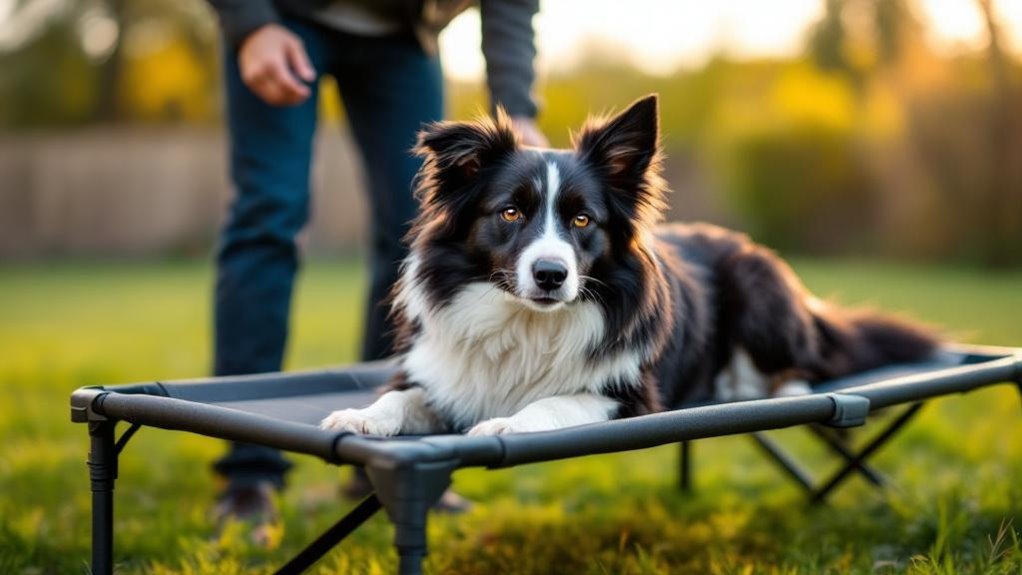
You can teach your Border Collie a solid place command by making one spot clear, calm, and worth staying on. Start with one cue, one mat, and one release word, then build time, distance, and distractions in small steps. If you rush, the command gets weak. If you keep it simple, your dog learns faster. The first step matters more than most owners think.
- Key Takeaways
- What the Place Command Means
- Start With Why Place Matters
- Pick the Right Mat for Place Training
- Grab Treats, a Marker, and a Leash
- Teach a Clear Release Word
- Introduce the Mat and Reward Interest
- Shape Four Paws on the Mat
- Add a Down on Place
- Add the Place Command Cue
- Build Duration One Step at a Time
- Add Distance to Place Training
- Proof Place With Distractions
- Use Place Daily and Fix Mistakes
- Frequently Asked Questions
- Conclusion
Key Takeaways
- Use a stable, non-slip mat and reward any interest until your Border Collie confidently puts all four paws on it.
- Add the cue “place” only after repeated success, then teach a clear release word like “free” that always means leave.
- Build duration first in 5–10 second steps, rewarding calm stays and advancing only after three to four consecutive successes.
- Once one-minute stays are solid, add distance gradually, then proof with mild distractions like movement, toys, doorbells, and new rooms.
- If your dog breaks place, lower duration, distance, or distractions and rebuild success with short 5–10 minute sessions daily.
What the Place Command Means
The Place command means your Border Collie goes to a set spot, like a mat, bed, or cot, and stays fully on it until you give a clear release word.
The Place command teaches your Border Collie to go to a defined spot and stay there until released.
In practice, your dog can sit, lie down, or stand calmly, but the full body stays on the place mat. You teach one clear verbal cue, such as “place,” and one release cue, such as “free.”
Your Border Collie should remain there until you release him, not until he gets bored or sees something interesting.
As training improves, you’ll use the Place command from different angles and distances. You’ll also build longer stays, starting with short holds and working up over time.
The finished behavior looks simple: your dog goes to the spot, settles, stays put, and leaves only when you give the release cue.
This can also help redirect boredom-driven behavior in energetic Border Collies.
Start With Why Place Matters
For a Border Collie, Place gives you a clear way to build calm and control in daily life. You can use it to stop jumping, barking, and chaos when distractions show up like guests, meals, or the doorbell. It also gives your dog a safe spot to settle, so you can work while your dog stays calm and focused. Adding calming routines indoors can help reduce boredom and make Place training easier to maintain.
Everyday Calm And Control
Often, Place matters most in daily life because it gives your Border Collie one clear job: settle on a mat and stay calm. That simple Place’ Cue helps your dog to settle instead of pacing, herding, or interrupting you during normal routines at home.
Start once your dog knows down and a release word like free. Keep the mat special. Give high-value treats, chicken, cheese, or a favorite chew only there. Then put the mat away between sessions so it stays meaningful.
Train in short sessions, five to ten minutes, a few times each day. Border Collies learn fast, but they can lock onto patterns. Practice from different angles and in different rooms.
Build time first. Aim for calm one-minute stays, then longer, until staying relaxed becomes a daily habit.
A calm zone can also help your dog learn that settling in one spot means relaxation, not just obedience.
Manners Around Distractions
Usually, Place matters most when life gets busy. Your Border Collie needs one clear job when the doorbell rings, guests arrive, or you cook dinner. A reliable place gives you a steady way to redirect that herding brain before excitement spills over.
Make the spot easy to love. Use a clear mat and high-value treats. Mark and reward fast, within a second, so your dog links the action to the reward. Build success in steps. First add a little time, about 10 to 30 seconds. Then add distance by sending your dog from farther away. Last, add mild distractions, like a bell sound or someone walking in.
Keep sessions short. Mix food, toys, and praise. If your dog breaks place, lower distractions or distance and rebuild success first. Pair place with impulse control so your Border Collie can hold position when excitement spikes.
A Safe Relaxation Spot
A place cue gives your Border Collie a clear way to settle when the house gets busy. For this breed, that matters. It turns herding energy into stillness and gives your dog one safe job during meals, guests, or training.
Use a non-slip mat, cot, or dog bed that fits your dog well. Start place work after your dog knows down. Use small soft treats so your dog stays engaged and doesn’t pace. Pair the cue with a clear release word like free.
Build time first. Aim for one to two minutes before you add distance or distractions. Border Collies notice every move you make, so don’t rush. Add a KONG, chew, or snuffle mat to help your dog relax. That makes place useful in new or stressful settings too.
A first-time owner should also keep sessions short and consistent, because Border Collies can be intense for beginners.
Pick the Right Mat for Place Training
Your mat sets the rules for place training, so pick one that stays put and gives your Border Collie a clear target.
A stable mat gives your Border Collie a clear place target and makes training rules easier to understand.
Choose a mat with a distinct feel and a non-slip backing, like rubber or heavy neoprene. Your Border Collie moves fast, so the mat shouldn’t slide during pacing or turns.
Make the place mat big enough for a full down and an easy turn. For most adult dogs, start around 36 by 24 inches. Go larger if your dog has a long body.
Pick a portable mat you can wash often. Outdoor fabric or washable fleece over a firm pad works well indoors and outside.
Use a clear edge or contrasting color. It helps your dog see the place area fast.
Choose durable, chew-resistant material with reinforced seams too. A few engaging puzzle toys can also help reinforce calm, focused behavior during training breaks.
Grab Treats, a Marker, and a Leash
Chicken, a clicker, and a 6-foot leash give you everything you need to start. Grab treats that are small, soft, and high value, like diced chicken or cheese. Your Border Collie learns fast, so use only 10 to 15 treats in a 5 to 7 minute session.
Keep your marker ready. A clicker works well, or you can use a clear word like “yes.” Tight timing matters, and immediate feedback helps your dog learn the right behavior faster.
Have a flat leash and a secure collar or harness on hand. The leash helps you guide early sends to the mat and stops quick bolt-offs.
Use a treat pouch so rewards stay close. Count or pre-weigh treats first, then trim meal portions if needed that day.
Short daily sessions and reward-based shaping help your dog learn the place command efficiently.
Teach a Clear Release Word
Pick one clear release word like “free” or “okay,” and use it only when you want your Border Collie to leave the place.
Then teach that word by saying it and immediately encouraging your dog off the mat, so they learn the word means permission to move.
If your dog breaks early, shorten the hold and reinforce leaving only after you give the release.
Keep short daily practice sessions to help your Border Collie stay calm and understand the command more quickly.
Choose The Release Cue
Choose one short release word like “free,” “ok,” or “release,” and stick with it every time. Your Border Collie needs one clear cue that means they may leave the mat. Keep the word short and distinct so it stands out from other commands.
Teach the release before you ask for long stays. Reward a brief pause on the mat, say your cue, then reward off the mat right away. That helps your dog link the word with movement.
Use the same tone and timing each time you give the release. Don’t say free in casual talk. Don’t use it during corrections.
Practice in new rooms and at different distances. If your dog gets up early, guide them back calmly, reset, and only give the release after the correct stay.
Pair the release with precise reward timing so your dog quickly understands exactly when the stay ends.
Reinforce Leaving Permission
Once you’ve picked your release word, make it mean one thing every time: your Border Collie now has permission to leave the place. Say it once, wait one second, then help your dog move off the mat. When you give a release, toss a treat a short distance so leaving predicts reward.
- Use one clear release word every time.
- Practice 10 to 20 short repeats per session.
- Change rooms, duration, and distractions.
- Never use the cue for anything negative.
Keep the pattern simple. Your dog stays, hears the release word, then moves and gets paid. That’s how you teach permission, not guessing.
Proof it in real life too. Practice after longer stays, near toys, or when the doorbell rings. Only say the cue when you truly want your dog to leave the place.
Introduce the Mat and Reward Interest
Start by placing a distinct non-slip mat in the middle of the room, then mark or click the instant your Border Collie sniffs it or puts a paw on it.
Place a clear non-slip mat in the center, then mark the moment your Border Collie notices or touches it.
Use tiny high-value treats like chicken or cheese. Drop the reward right on the mat so your dog links that place with good things. Keep your timing sharp and your movements quiet. You want interest to grow without pressure. Don’t lure or force your dog onto the mat.
Keep each session short, about five to seven minutes. Aim for ten to fifteen marked interactions each time. Border Collies learn fast, so brief repeats work well.
Change rewards now and then. You can also set a favorite toy or chew on the mat. Wait to name the behavior until your dog seeks out the mat on its own.
Shape Four Paws on the Mat
Set the mat in the center of the room and shape the behavior in small steps. Use a clear non-slip mat so your Border Collie can approach from any side. Reward any interest first, then raise your standard until all four paws land on the mat. You can lure your dog with a treat, but fade that help fast.
- Mark a sniff, step, or paw touch early.
- Wait for closer tries before you reward again.
- Click when four paws are fully on the mat.
- Feed on the mat to strengthen the choice.
Keep sessions short, about five to seven minutes. Aim for three unprompted successes in a row. If one paw hangs off, quietly guide it back. Then reward when all four paws stay contained. Build reliability before asking for more time.
Add a Down on Place
When your Border Collie can reach the mat and stay there with ease, teach a down by lowering a high-value treat from your dog’s nose to the mat and back between the paws until the body folds to the floor.
The moment your dog lies down on the mat, mark it, then place and give the reward on the mat.
If your dog keeps sitting, shape the motion in small steps. Mark head drops, then elbows touching, then the full down on the mat.
Build duration slowly. Ask for 10 seconds, then 30, then a minute. Add mild distractions and a little distance before you ask for more time.
If your dog breaks position, guide them back calmly and make the next rep easier.
Later, add the verbal cue once the behavior is reliable.
Add the Place Command Cue
Name the behavior only after your Border Collie already runs to the mat and stays there with little help, usually after 15 to 30 solid guided reps in a few spots.
Then add your cue. Say “Place” or “Mat” one time as you send or lure your dog onto it. Mark and reward as soon as all four paws land.
- Use one short cue word every time.
- Pair it with a clear release word like “Free.”
- Fade the lure over the next few trials.
- If your dog misses, make it easier again.
Your Border Collie should learn that Place means go there and stay there until you say Free. That clear pattern matters with a fast, busy dog.
If the new cue causes mistakes, step back, re-lure, and rebuild clean reps before saying the cue again.
Build Duration One Step at a Time
Now build time in small steps so your Border Collie can succeed without guessing. To build duration, add only 5 to 10 seconds after each success. Keep your dog on the mat while you stay still. Ask for the new time three times in a row before you increase the amount again.
Use a clear release word like “free” so your dog knows when the job ends. Keep sessions short, about 3 to 5 minutes total. During longer holds, toss a high-value treat onto the mat every 20 to 45 seconds. This keeps motivation up while your dog learns to settle. Then reward less often over time.
If your dog gets off early, shorten the time right away. Practice that easier step again. Move forward only after three steady, clean successes.
Add Distance to Place Training
After your Border Collie can hold place for one full minute, start adding distance in small, clear steps. Step back one stride, cue place, and reward at once. Then add distance by only one or two strides each session.
- Start with a 6-foot leash for close sends.
- Switch to a long line at 15 to 20 feet.
- Practice measured sends at 2 m, 5 m, and 10 m.
- Require four straight wins before you increase range.
Keep sessions short, about five to ten minutes. Use high-value treats or a favorite chew on the mat as distance grows. At each range, change your position. Walk away, sit down, turn your back, or briefly leave the room.
If your dog breaks place in over 20 percent of tries, move closer again.
Proof Place With Distractions
With a solid one-minute hold in a quiet room, you can start proofing Place with small, planned distractions.
Toss a treat three to five feet away. Play TV sound for 30 seconds. Use a squeaky toy once. Reward only if your Border Collie stays fully on the mat.
Next, add doorbell practice. Play a recorded bell or have someone ring it outside ten times. Cue place and pay only when all four paws stay on the mat the whole time.
Then add movement. Walk five to ten steps away. Let another person pass at three to five feet. Drag a toy on leash. Increase difficulty only after three straight successes.
Change locations too. Practice on a rug, tile, and patio. Aim for four solid 60-second holds at each spot. Use a lick mat or chew if arousal rises.
Use Place Daily and Fix Mistakes
Place gets stronger when you use it every day, not just in practice setups. You should practice the place command in short daily sessions. Aim for three sessions a day. Keep each one 5 to 10 minutes so your Border Collie stays sharp.
- Use high-value treats or a favorite chew on the mat.
- Remove the reward between sessions to keep the mat special.
- Track four solid 1-minute stays before longer holds.
- Then get four solid 5-minute stays before harder setups.
When your dog gets up, fix mistakes right away. Step back by lowering distance, time, or distraction. Rebuild to the last reliable level, then move on. If the doorbell or guests cause errors, guide your dog back, reward compliance, and repeat that exact scene in controlled drills later.
Frequently Asked Questions
What Is the 7 7 7 Rule for Dogs?
The 7-7-7 rule means you train your dog in three manageable parts: 7-second holds, 7-step distance sends, and 7 repetitions per session. You build reliability gradually, keep sessions short, and reduce pressure on your dog.
How to Train a Place Command Puppy?
Like a town crier, you’ll train place by rewarding your puppy for stepping onto a non-slip mat, then staying. Add “place” once consistent, build duration and distance gradually, use release word, and keep it positive.
What Is the 3-3-3 Rule for Dog Training?
You use the 3-3-3 rule by practicing three reps per session, three short sessions daily, for three days. You’ll keep training focused, prevent burnout, build consistency, and track success before increasing duration, distance, or distractions.
How to Train a Border Collie Basic Commands?
Start by teaching sit, down, come, and stay with high-value treats in 5–10 minute sessions. Use consistent cues and “free” release. Add impulse-control games, movement drills, and gradually increase distance, duration, and distractions daily.
Conclusion
Place training gives your Border Collie a clear job and a calm place to do it. Keep your cue simple. Keep your release clear. Keep your sessions short. That steady rhythm builds a dog who can settle, wait, and listen. If your dog breaks, reset and make it easier. Then try again. Small steps lead to strong habits. Use place every day, and you’ll turn one mat into a skill that helps everywhere in your home.