
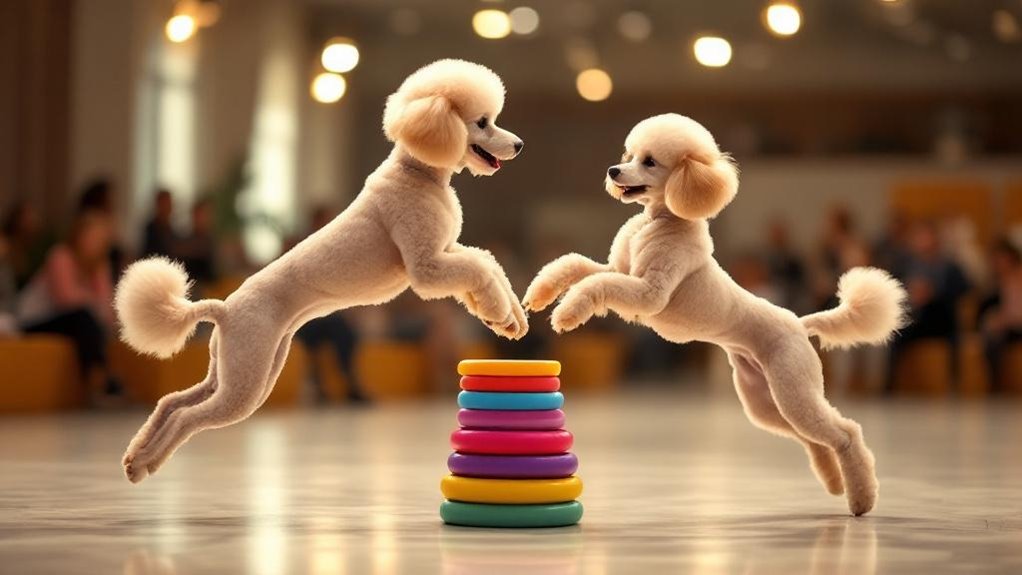
If you want your Poodle to do more than the usual sit and shake, you can teach a set of advanced tricks that look clean, smart, and hard to forget. You’ll start with clear cues, short practice, and strong rewards, then build spins, catches, weaves, and signal tricks step by step. The real shift comes when you link them into one smooth routine that feels like a performance.
- Key Takeaways
- Start Advanced Poodle Tricks the Right Way
- Set Up Your Poodle for Fast Wins
- Teach Your Poodle to Catch Reliably
- Teach Your Poodle to Spin Smoothly
- Teach Your Poodle Under the Bridge
- Teach Your Poodle Peekaboo
- Teach Your Poodle Leg Weaves
- Teach Your Poodle to Speak on Cue
- Teach Your Poodle Yes and No
- Chain Advanced Poodle Tricks Together
- Frequently Asked Questions
- Conclusion
Key Takeaways
- Build advanced tricks on reliable sit, stay, recall, and loose-leash walking practiced calmly in varied locations.
- Keep training short and rewarding: 3–8 minute sessions, high-value treats, immediate markers, and gradual progression.
- Teach flashy movement tricks like spins and leg weaves by luring first, then adding cues and fading the lure.
- Impress with through-and-around tricks like peekaboo and under-the-bridge, rewarding partial successes before chaining full behaviors.
- Train catches with gentle underhand tosses at eye level, starting close and increasing distance only after consistent success.
Start Advanced Poodle Tricks the Right Way
Before you teach advanced tricks, make sure your Poodle has solid basics in place. Aim for sit, stay, recall, and loose-leash walking at 80–90% in different places. That keeps training clear and safe.
Match each session to your dog’s size and energy. Standard Poodles usually need a 15–20 minute warm-up. Toys and Minis do better with shorter bursts and more mental stimulation.
Use Positive reinforcement and short frequent training blocks. Train for 3–5 minutes, 3–6 times a day. Switch between small soft treats, a favorite toy, and praise to hold focus.
Teach new tricks with lures or by capturing the behavior. Then add a clear verbal cue and release word. Fade the food lure after 10–20 good repeats. Practice in new places to build reliability.
Miniature Poodles often do best with shorter, more frequent sessions because they can be more easily distracted and benefit from added mental stimulation.
Set Up Your Poodle for Fast Wins
Since Poodles learn fast, keep each training session short and clear. Work for 5 to 10 minutes, two or three times a day. That pace gives your dog steady mental exercise without boredom. It works well for Toy Poodles too.
Start New tricks in a quiet room your dog already knows. Remove distractions and use a high-value treat like soft cheese or boiled chicken. Reward small steps right away with a click or treat. Don’t add a cue until your Poodle repeats the behavior 8 to 12 times.
Choose easy wins that grow from skills your dog already has. Lure a spin from a sit or shape peekaboo from walking through your legs. Change rewards and practice spots every few sessions. That keeps your Poodle alert, responsive, and ready to learn more.
Impulse control training can help your Poodle stay calm and focused as new tricks get harder.
Teach Your Poodle to Catch Reliably
Often, the best way to teach catching is to start with your Poodle sitting right in front of you. Get steady eye contact with a high-value treat. Then gently toss a small soft treat underhand at shoulder height. Your dog should see it early and reach for it in the air.
If you want to teach your dog faster, keep the throw easy and predictable. If your Toy Poodle misses, calmly pick up the treat first. Then repeat from a shorter distance. That builds confidence and impulse control.
When catches become solid, switch to light poodle-safe toys like a soft ball. Keep throws at eye level and increase distance slowly. Praise every success. Add a treat or quick play break. Keep sessions to five or ten minutes. Practice often each day. Calm greetings and four-paws-on-the-floor rewards can also help your Poodle stay focused and controlled during training.
Teach Your Poodle to Spin Smoothly
Catching work sets your Poodle up well for spins because your dog already knows how to follow your hand and stay engaged.
Catching games make spin training easier because your Poodle already follows your hand and stays tuned in.
Start in a quiet space with your dog standing. Hold a high-value treat above the nose and guide a large circle. Reward right when the spin ends.
Use short sessions, about three to five minutes, two or three times a day. This training approach keeps your Poodle focused. Aim for 10 to 15 good reps. Teach each direction on its own. Use “spin” for one side and “other” for the other side.
If your dog rushes, slow your hand. Reward halfway turns to shape smoother movement. Mark exact success with a clicker or “yes.” Then fade the lure over time and keep a small hand cue.
Keeping calm focus during training can also help reduce barking at everything by making your Poodle more settled and engaged.
Teach Your Poodle Under the Bridge
For this trick, sit on the floor and make a low bridge with your knees. Form a triangle, then lure your Poodle under with a high-value treat. Reward the moment your dog crawls through.
Keep training short so your dog stays focused.
- Practice 3 to 5 minutes, 2 or 3 times daily.
- After 10 to 15 good reps, fade the food lure to a hand signal.
- Add the cue “under” or “bridge,” then let the cue and hand motion lead.
Keep your knees low and move slowly. That protects the spine and joints, especially in a Toy and Miniature Poodle.
Next, practice in different rooms. Add mild distractions like another person or a toy. Your dog will learn the cue means the same thing anywhere.
Use short sessions so your poodle can stay engaged and learn the trick without losing focus.
Teach Your Poodle Peekaboo
Sit down with your knees raised like a bridge, then hold a treat at your waist and guide your Poodle through your legs. When your dog moves through, reward at once and repeat until the motion looks easy.
Then add the cue “peekaboo,” and start to fade the lure to an empty hand while you still reward good tries.
Keep the sessions short and playful so your dog stays sharp, just like short play sessions that help smart dogs learn new names and cues quickly.
Lure Between Legs
- Use 5–7 minute sessions.
- Reward partial tries.
- Praise calm, precise entries.
Repeat several times each day. If your poodle hesitates, lower your knees. You can also switch to a favorite toy or better treat. Don’t force the movement. Build confidence first.
Once peekaboo feels easy, reduce the food lure over a few sessions. Then practice with mild distractions. Later, try it standing, then while walking. Keep each repetition clean and calm. For extra enrichment, add scent games between training sessions.
Add The Verbal Cue
Now add the verbal cue once your poodle can move between your legs with a smooth lure. Start with your dog behind you. Hold a high-value treat at chest level and guide them forward. The moment they pass through, mark it and reward fast.
After 5 to 10 good reps, add a clear verbal cue like peekaboo or middle as your poodle starts moving. Say the word once, then lure. This helps your dog link the cue to the action.
Next, fade the lure over short sessions. Use an empty hand, then a small hand signal, then the word alone. Keep rewards strong at first and then vary them. Practice in a few rooms and outside with mild distractions. Train for 3 to 5 minutes, two or three times daily.
Use short sessions to keep your poodle focused and confident while learning.
Teach Your Poodle Leg Weaves
Begin in a quiet room with your Poodle on a loose leash and your feet about shoulder-width apart. Use a high-value treat to start weaving. Lure your dog behind your nearest leg and into the space between your legs. When your Poodle comes through, give praise and a reward right away.
- Guide your dog around the far side and back to front.
- Teach each side alone, then link them into leg weaves.
- Shorten the lure as your dog learns the figure-8 pattern.
Once your dog understands stationary leg weaves, take small steps and keep the motion smooth. Use an empty hand or small body cue as food fades. Reward some passes, not all. Keep practice to three to five minutes.
Repeat often. Move forward only when your Poodle stays calm and confident.
Short, reward-based shaping sessions can help your dog learn the pattern more efficiently.
Teach Your Poodle to Speak on Cue
Watch for the moment your Poodle wants to bark, like when the doorbell rings, then say “speak” or click the instant the bark happens and give a small high-value treat within 1 second.
Keep sessions short, about 5 to 8 minutes, two or three times a day. Training a Poodle works best when you move fast and stop before your dog gets bored.
Reward one brief bark. Don’t pay for a string of noise. That helps you avoid excessive barking and teaches control, not chaos.
When your dog barks on cue most of the time, add a quiet cue and reward silence right after the bark.
Then practice in new rooms, outside, and around distractions. If your Poodle cant focus everywhere yet, keep working in easier spots first and build gradually.
Teach Your Poodle Yes and No
You can teach your Poodle to answer with a head nod for “Yes” and a head shake for “No.”
Use clear hand signals, mark the exact movement right away, and reward each correct response so your dog links the action to the cue.
Keep sessions short, use the same cues every time, and practice in different places so the answers stay reliable.
Head Nod Cue
Often, this trick goes quickly with a Poodle because the breed notices small hand moves and tone changes. Start the head nod cue with a high-value treat in your closed fist near your dog’s nose. Move your hand up and down. The moment your dog dips its head, click or say a marker and reward within one second.
- Keep sessions to 3–5 minutes.
- Practice a few times each day.
- Fade the lure after 50–100 good reps.
Say “yes” as the nod happens. Keep your voice calm and positive. Theyre quick learners, so a well-trained Poodle often picks this up fast. Vary rewards with treats, praise, or a toy to prevent boredom. Soon, your dog will respond to the verbal cue and a small hand signal, not just the treat.
Head Shake Cue
Start the “No” cue with a clear side-to-side hand motion that mirrors the head shake you want. Hold a treat in a closed fist at your poodle’s nose level. Move your hand gently side to side. The moment your dog follows with a head shake, mark it with a click or a calm “Yes,” then reward right away.
Make sure you use a training approach that stays positive and clear. Keep your tone soft and your body relaxed, since poodles notice small changes. Practice for 3 to 5 minutes, two or three times each day. That keeps your dog focused without boredom. Once your poodle responds well, add the verbal “No” cue before the motion. Then fade the hand signal slowly. Reward off and on later to keep the trick strong.
Chain Advanced Poodle Tricks Together
Once each trick is solid on its own, chain them in a clear cue order such as spin, under, leg weave, then catch, so your poodle can move from one behavior to the next without a pause. Fade lures after 10 to 20 good reps and use the same hand signals each time. Mark each step with a click or “Yes,” then pay after the full chain.
- Reward about 60% of chains.
- Add toy praise and jackpots.
- Build distance and distractions slowly.
Practice links in new places for 5 to 7 short sessions before you join them. Add turns, noise, and people in small steps. Teach an exit cue like “out” or use a release toss. If your dog misses a cue, stop, re-cue, and reward the fix. That keeps the chain strong and clean.
Frequently Asked Questions
How to Give a Poodle Mental Stimulation?
Give your Poodle 15–30 minutes of daily brain work: puzzle feeders, scent games, and short trick sessions. Rotate activities every 5–10 minutes, vary rewards, change locations, and add classes or supervised play for social challenge.
What Are the Most Complex Dog Tricks?
Like solving a moving puzzle, you’ll find the most complex dog tricks combine chained sequences, scent discrimination, named-object retrieval, leg weaves, figure-8 shifts, and distraction-proofed impulse control; they demand precision, repetition, and weeks of patient training.
Do Poodles Have a High IQ?
Yes, you can consider Poodles highly intelligent; they rank among top dog breeds for obedience and problem-solving. You’ll notice they learn cues quickly, detect inconsistency, and need daily mental challenges to stay engaged and well-behaved.
What Is 15 Minutes of Mental Stimulation for Dogs?
What counts as 15 minutes of mental stimulation for your dog? You can do three five-minute tasks: a scent game, puzzle toy, and training drill. Vary rewards, and aim for two daily sessions to curb boredom.
Conclusion
You’ve taught more than party tricks. You’ve built focus, timing, and trust. Keep sessions short. Pay well. Fade help slowly. Then practice in new places until your poodle works like a tiny stage manager in a fur coat, hitting cues while the human assistant tries to keep up. That picture is silly, but the lesson is plain. Train cleanly. Reward often. End with success. Your poodle won’t just impress people. Your poodle will know exactly how to do it.