
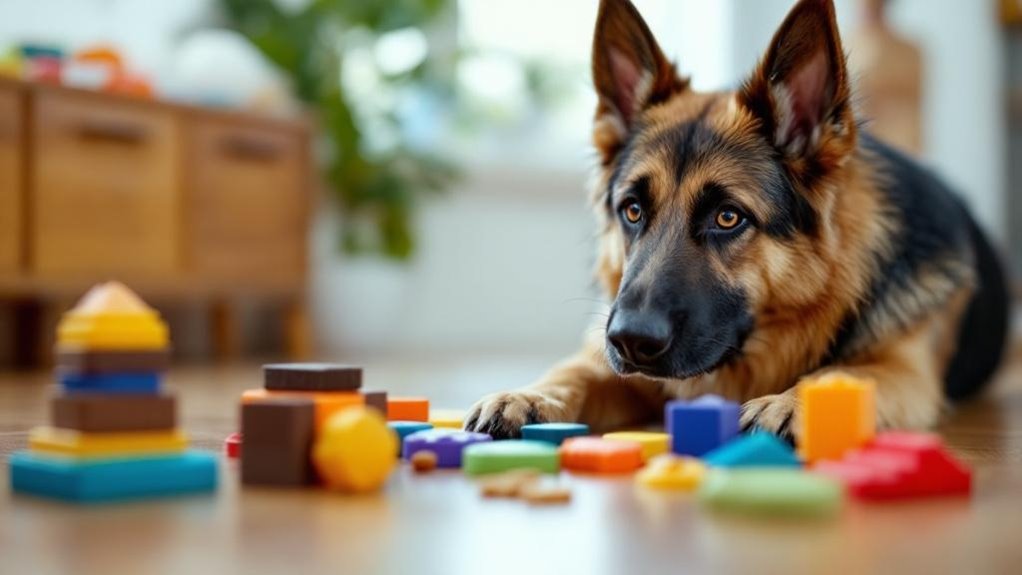
By chance, the same games that keep your German Shepherd busy can also show you how its mind works. You can use simple tasks like hide and seek, scent trails, and cup puzzles to test focus, memory, and self-control. Keep each session short, use one clear cue, and track what changes from day to day. The patterns you notice may tell you more than a quick win ever could.
- Key Takeaways
- What Brain Games Reveal About Your Dog
- How to Measure German Shepherd Intelligence
- Set Up Your Intelligence Test
- Start With Hide and Seek
- Try a Treasure Hunt
- Build a Scent Trail
- Teach the Shell Game
- Make a Muffin Tin Puzzle
- Use Eye Contact as a Focus Test
- Use Walks to Test Self-Control
- How to Increase Puzzle Difficulty
- Signs Your German Shepherd Is Learning
- Mistakes to Avoid During Brain Games
- Frequently Asked Questions
- Conclusion
Key Takeaways
- Test German Shepherd intelligence with 6–8 short games covering scent, memory, impulse control, tracking, and simple problem-solving.
- Start in a quiet familiar space, use one cue like “search,” and keep sessions to 10–15 minutes.
- Use scent games like hidden toys, cup searches, and short sock trails to measure focus, persistence, and nose use.
- Try muffin tin puzzles and shell games to assess memory, attention, adaptability, and correct-choice accuracy.
- Begin with easy visible setups, increase difficulty gradually, and record solve times, distractions, and repeated errors.
What Brain Games Reveal About Your Dog
Start with simple brain games and watch what your German Shepherd shows you.
Begin with easy brain games and notice what your German Shepherd reveals through focus, curiosity, and problem-solving.
Scent games are mentally stimulating and useful. Hide a toy or make a short trail with a sock. You’ll see how your dog uses scent, stays on task, and solves problems fast. Scent work can also build focus and confidence as your dog learns to follow a clear find-it cue.
Try puzzles next.
A muffin tin or snuffle mat shows how well your dog remembers where treats are and how quickly it adjusts when you change the challenge.
Shell games do something different. They show attention and choice control as your dog tracks food under cups.
Add impulse games like Red Light, Green Light or eye contact practice. You’ll notice better self-control and focus.
Toy pick-up and treasure hunts reveal how well your dog follows your cues and works with you each day.
How to Measure German Shepherd Intelligence
Measure your German Shepherd’s intelligence by looking at a few clear skills, not one test alone.
Start with problem solving. Note how fast your dog finishes simple puzzles like a muffin tin or nesting bowls. Faster times often show better mental flexibility.
Then check learning speed. Teach one new verbal cue and count how many repeats your dog needs. Many German Shepherds learn in fewer than five tries.
Also measure scent work. Use one scent trail and record how accurately and quickly your dog finds the target as the trail gets harder.
Watch social understanding too. Score how your dog responds to pointing, eye direction, and commands in new places.
Last, test memory. Teach two tasks, wait one to three days, then record how much your dog still remembers accurately.
German Shepherds are known for working obedience intelligence, so strong scores often show up in command retention and task performance.
Set Up Your Intelligence Test
Pick 6 to 8 short tasks that test different skills, like a hidden-toy game, a two-cup shell game, a muffin tin puzzle, a short scent trail, a memory task, and a simple obstacle.
Use a quiet, familiar space so your German Shepherd stays focused. Keep the full session to 10 to 15 minutes. Short tests work best.
Choose one start cue, like “search,” and use it every time. Keep your reward rule the same too. Give small pieces of sausage or cheese right away when your dog succeeds.
Start easy. Use a visible toy or simple shell game before harder rounds. Add challenge step by step.
Write down solve time and repeats needed. Note distractions, your movement, and leash use. Test at the same time each day, even for Hide and Seek.
Keep each round short because brief sessions help prevent mental fatigue and make new information stick better.
Start With Hide and Seek
Ease into hide and seek by teaching a solid stay first, or have a helper hold your German Shepherd while you hide and give one clear cue like “go find it.” Let your dog sniff you, or a favorite toy or treat, before each round so it has a scent to follow.
Start in one small room with easy places to Hide. Reward every find right away with a great treat or clear praise. Keep each round simple so your dog learns the pattern fast.
Then make the game harder little by little. Hide farther away. Use a second room. Add a chair or open door as an obstacle. Have your helper move off briefly so your dog follows scent, not sight. Keep sessions short, about five to ten minutes, so your Shepherd stays focused and wants more.
For the best results, keep your dog under its threshold level so the game stays fun and confidence-building.
Try a Treasure Hunt
Set up a simple treasure hunt by showing your German Shepherd the toy first and letting them sniff it and hold it for a moment. That helps them know what to search for.
Start in a small room with few hiding spots. Ask your dog to stay, or have someone hold them, then say, “go find it.” Keep the first hides easy so your dog can win.
As your German Shepherd improves, make the treasure hunt harder. Use larger spaces. Hide the toy behind furniture or under a blanket. Add a few mild distractions only after your dog succeeds often.
Praise every find right away. Give the toy or a treat to reward the effort. Over time, use fewer food rewards.
Sniff games and other low-cost enrichment activities can also help reduce boredom. Practice several short sessions each week to build focus, problem-solving, and a stronger bond.
Build a Scent Trail
To build a scent trail, start with an old sock tied in a knot and fill it with a strong-smelling food like cheese or sausage.
Drag the sock along the ground to make a clear trail. Start in a quiet spot with few distractions. Let your dog sniff the sock first. Then give a simple cue like “search” and release them to follow the scent. Keep early trails short, just a few meters. Reward success with the sock food or high-value treats.
As your dog improves, make the nose work harder. Add curves or make the trail longer, even past 20 meters. Hide the sock under a box or brush. Wait a bit before sending your dog. Use “all done” at the end. Keep sessions to 5 to 10 minutes. These short brain training games can also improve focus and calmness while reducing boredom-related behavior issues.
Teach the Shell Game
When your dog picks the right cup with confidence, add a third cup and shuffle them slowly so it can track the scent and solve the problem.
Keep sessions short, raise the difficulty a little at a time, and always praise and reward your dog so it stays focused and willing to try.
This kind of progressive challenge helps build coordination, focus, and problem-solving skills over time.
Shell Game Setup
On a flat surface, place three identical smooth cups and let your German Shepherd watch as you hide a small, strong-smelling treat like cheese, liver, or sausage under one cup. This clear setup builds the first link and gives useful mental stimulation.
If your dog is new to the game, start with only two cups. Add the third cup after your dog picks correctly with confidence.
Let your dog sniff the treat first. Then hide it and use one start cue, such as “search” or “find it.” Keep movement slow and easy to follow.
When your dog noses, paws, or tips the right cup, reward at once. Give the treat and calm praise. That quick feedback strengthens the choice.
Short play sessions can help your dog stay focused and learn the game without getting frustrated.
End each round with the same finish cue, like “all done.”
Increase Shuffle Difficulty
Now make the game a little harder so your German Shepherd has to track the right cup instead of guessing.
Begin with two identical cups on a smooth surface. Let your dog sniff a small smelly treat like cheese or sausage. Hide it under one cup. Give your start cue, “search.” When your dog finds the right cup, reward at once and encourage your dog with calm praise.
When that becomes easy, add a third cup. Shuffle slowly and one step at a time. Let your dog follow the movement and scent. Later, wait longer before the search. Change cup positions or try different surfaces. Briefly block the cups so your dog uses scent, not just sight. If your dog guesses wrong, reset fast and repeat. Keep sessions to 5–7 minutes and end on success.
For extra variety, try nose work games or other indoor enrichment to keep the exercise mentally challenging.
Make a Muffin Tin Puzzle
Build a simple muffin tin puzzle with a standard 12-cup tin, a few high-value treats, and tennis balls. This is one of the best Fun Brain Games for testing your German Shepherd’s problem-solving skills at home.
Turn a 12-cup muffin tin, treats, and tennis balls into a simple brain game your German Shepherd will love.
- Put soft cheese, sausage bits, or freeze-dried liver in 4 to 6 nearby cups first.
- Cover each treat cup with a durable tennis ball, then reduce treats to 1 or 2 scattered cups later.
- Keep rounds to 5 to 10 minutes, supervise closely, and praise each correct find.
You can repeat the puzzle 2 to 4 times in one session. Let your dog eat each treat after solving it. For more challenge, swap in cloth or plastic lids, or freeze treats in the cups. That builds nose-work and mental mapping. It also keeps training fresh and focused.
Use Eye Contact as a Focus Test
You can test your German Shepherd’s focus by teaching a simple “look” cue and rewarding steady eye contact. Start with short looks, then time how long your dog can hold your gaze as you slowly build the duration.
This also gives you a calm way to reward attention and replace tense or reactive behavior.
Teaching The Watch Cue
Start with a simple focus test. Hold a high-value treat at your forehead and say “watch.” The moment your German Shepherd makes eye contact, reward within one to two seconds. That timing teaches the cue fast and keeps the meaning clear.
Keep practice short and repeat it daily.
- Do 5 to 10 reps, 2 to 3 times a day.
- Replace the visible treat with an empty hand over 1 to 2 weeks.
- Add mild distractions like another room, a doorbell, or a person nearby.
Only reward correct responses when distractions appear. Then switch to rewarding about 60 to 80 percent of good efforts. Use calm praise too. You can use watch before walks, during recall, or at the vet to build steady attention and support calmer behavior.
Measuring Focus Duration
Once your German Shepherd knows the watch cue, time how long they can hold eye contact on command to get a clear focus baseline. Use a brief food lure at first, then fade it. Run five 30-second trials and record the average hold time.
Use a stopwatch. Note the setting and distractions like toys, people, or other dogs. Most trained adults hold focus for 10 to 20 seconds early on. With daily practice, many reach 30 seconds or more. Busy places can cut focus by 40 to 70 percent.
Repeat the test each week. Add small challenges like longer waits, more distance, or light distractions. Track the percentage gain. You can also reward your dog after a hold, then ask for a scent game to check how well focus carries into another task.
Rewarding Calm Attention
Often, the best way to test calm attention is with eye contact. Teach “look” by holding a treat near your forehead. Reward after 1 to 3 seconds of eye contact, then slowly build to 10 to 15 seconds. This shows whether your dog can stay settled and focused.
- Reward treats on about 70% of good looks
- Use praise or a toy for the rest
- Test in a quiet room, backyard, then busy park
Run 3 to 5 short trials each session. Record success rate and average eye-contact time. Make sure you score each look clearly: 0 to 2 seconds is poor, 3 to 6 is fair, 7 to 10 is good, and 11 to 15 is excellent. End with “all done” and a calm reward.
Use Walks to Test Self-Control
During walks, you can test your German Shepherd’s self-control with simple stop-and-wait drills. Pause at random, give a clear red light cue, and expect your dog to stop and sit after 3–5 repetitions when you reward calm behavior.
Start with a short lead. Ask your dog to wait until you give a green light release. Change routes and add mild distractions like distant dogs, cyclists, or squirrels. Watch whether your dog holds position or breaks at the first trigger.
Also change direction and make sudden stops. Call your dog and see how fast it reorients to you. Strong focus shows up within 1–2 seconds.
Score each walk: 0 for an immediate break, 1 for brief resistance, 2 for holding position, 3 for holding and eye contact. Track scores weekly.
How to Increase Puzzle Difficulty
As your German Shepherd gets better, make each puzzle a little harder so the work stays clear and fair. That keeps mental exercise useful, not random.
As your German Shepherd improves, raise the challenge a little at a time so the work stays fair, focused, and useful.
- Hide rewards by scent only. Start with visible treats, then use a sock with cheese and drag a trail from 5 feet to 30 or more across grass, pavement, or carpet.
- Add steps. Try a 12 cup muffin tin with only 3 rewards, then swap tennis balls for heavier lids. You can also ask for a stay, then a short scent trail, then a three cup choice.
- Make the dog work longer. Freeze treats, stack nesting bowls, add mild noise or other smells, and give 30 to 60 seconds at first. Use fewer hand cues over repeated tries, then shorten the time when accuracy stays strong.
Signs Your German Shepherd Is Learning
You’ll notice learning when your German Shepherd responds to commands faster and needs fewer repeats.
You can also watch for better problem solving, like finding treats with less trial and error in simple games.
Stronger scent skills show up when your dog tracks a faint trail or finds a hidden toy with more confidence.
Faster Command Response
One clear sign your German Shepherd is learning is a faster response to a cue. With German Shepherds, speed matters because it shows the command is becoming familiar, not just guessed.
Watch for these signs during short training sessions:
- Your dog learns a new verbal cue in 1 to 5 repetitions.
- Response time drops from several seconds to under 1 to 2 seconds.
- Your dog follows the cue in new places within 10 to 15 successful tries.
You should also notice less dependence on food. After 5 to 20 sessions, your dog may respond to a hand signal or an empty-hand verbal cue. That shows true cue association.
You may even see the behavior offered before you ask, like a sit before a walk. That suggests strong retention and steady attention over time.
Better Problem Solving
Speed on cues matters, but real learning also shows up when your German Shepherd faces a new problem and changes tactics.
If your dog stops pushing at a barrier and circles around it to reach a toy, you’re seeing flexible thinking, not blind persistence. That shift shows planning.
Watch how fast your dog improves over repeats. If a new puzzle is clear within three to five tries, your dog is learning rules and applying them fast.
You can also raise difficulty in simple hide-and-find games. Start easy, then add more spots or small changes. If success stays steady, your dog is building endurance and better task focus.
Memory matters too. If your dog remembers where an item was hidden after a delay and uses that experience in new setups, learning is sticking.
Stronger Scent Skills
Often, stronger scent skills show up when your German Shepherd finds a hidden treat or toy faster and with less wandering. That shows a sharper sense of smell and better search focus.
You may notice clear changes during simple nose-work games:
- Your dog finds obvious hides in under 30 to 60 seconds.
- Your dog tracks a scent trail for minutes and stays on task.
- Your dog solves harder hides in new rooms or raised spots.
You should also watch for better accuracy. In shell-game trials, your dog may alert to the right cup more often after training. A rate above 70 percent shows stronger scent cues and better scent resolution.
Another sign is independence. Your dog chooses correctly without repeated prompts. When the target appears, calm excitement and quick reward interest show growing confidence too.
Mistakes to Avoid During Brain Games
While brain games can sharpen your German Shepherd’s focus, a few common mistakes can slow progress or create new problems. Don’t rely only on treats. Mix in praise, play, and toy rewards so your dog stays interested after repeated tries.
Also, avoid making tasks physically frustrating. Tight puzzles and shaky surfaces can stress joints. Keep age and fitness in mind, and raise difficulty in small steps.
Use clear cues like “search” to start and “all done” to finish. If your signals change, your dog gets confused and learns more slowly.
Keep early games simple. Start in a small, quiet space and use only two or three hiding spots until your dog succeeds often.
Stay close during puzzle play. Chewable parts can break, and your dog may swallow them.
Frequently Asked Questions
What Is the IQ Level of a German Shepherd?
You can’t assign a human-style IQ number to a German Shepherd, but you’d consider them highly intelligent. They learn commands fast, solve problems well, and often rank among the top breeds for obedience, working ability, and trainability.
What Is the Number One Cause of Death in German Shepherds?
Cancer is the number one cause of death in German Shepherds. You should watch for lumps, weight loss, or behavior changes, because early vet checkups and diagnostics can catch cancers like hemangiosarcoma, lymphoma, or osteosarcoma sooner.
What Is 15 Minutes of Mental Stimulation for Dogs?
Fifteen minutes of mental stimulation means you engage your dog’s brain, challenge its nose, and reward its focus through brief scent games, puzzle toys, or training bursts that curb boredom, sharpen attention, and build confidence.
What Is the Hardest Age With a German Shepherd?
The hardest age with a German Shepherd is usually adolescence, around 6 months to 2 years. You’ll see testing, chewing, distractibility, and setbacks. Keep training short, add mental work, and get help for reactivity.
Conclusion
These brain games give you a clear window into your German Shepherd’s mind. You’ll see how your dog solves problems, follows scent, remembers steps, and controls impulse. Keep each test short, steady, and fair. Write down what happens, then adjust the challenge like turning a dial, not flipping a switch. Over time, small clues stack up like footprints in fresh snow. They show how your dog learns and where you can help it grow.