
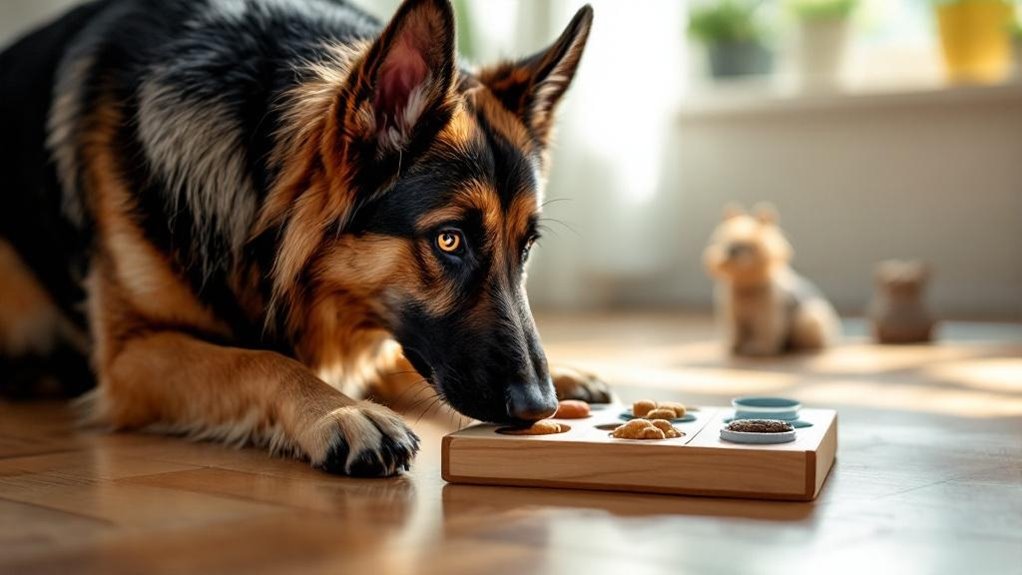
You don’t need special gear or a lot of time to give your German Shepherd real brain work. These dogs do best when you turn drive and energy into clear tasks. Start with basic cues and eye contact, then use simple games like treat hunts, toy searches, and short obstacle work. Keep each session brief and reward success fast. A few small changes can sharpen focus and cut problem behaviors.
- Key Takeaways
- Why Brain Games Help German Shepherds
- Teach Basic Cues Before You Start
- Teach Eye Contact for Better Focus
- Play Easy Treasure Hunt Brain Games
- Try Hide-and-Seek With Toys
- Build Scent Skills With Hot and Cold
- Use a Snuffle Mat for Nose Work
- Set Up the Three Cups Game
- Make a DIY Treat Puzzle
- Teach Toy Names and Search Games
- Turn Walks Into Outdoor Brain Games
- Set Up an Obstacle Course Game
- Frequently Asked Questions
- Conclusion
Key Takeaways
- German Shepherds need brain games because mental work channels their drive and reduces boredom-related chewing, barking, and restlessness.
- Start with basic cues like sit, stay, come, leave it, and watch me before harder problem-solving games.
- Use nose-work games like treasure hunts, hide-and-seek, and scent trails with cues such as “Search!” and “Finish!”
- Try simple puzzles like snuffle mats, hidden treats, and toy-finding tasks, increasing difficulty gradually as your dog succeeds.
- Keep sessions short and rewarding: 3–10 minutes for most games, up to twice daily, ending with praise or play.
Why Brain Games Help German Shepherds
Because German Shepherds were bred to herd and protect, they need more than long walks to stay balanced.
You need to give them mentally stimulating work that uses their drive and sharp thinking.
Brain games for dogs help channel that energy into a clear job.
When your dog solves scent puzzles, finds hidden treats, or works through toys, you reduce boredom.
That matters because boredom often shows up as chewing, barking, or restless behavior.
Even 15 to 30 minutes a day can improve focus, impulse control, and reliability.
These games also build confidence.
Start simple with a snuffle mat.
Then make tasks harder over time.
Your dog stays engaged instead of getting used to one easy routine.
That steady challenge supports a calmer, more capable German Shepherd every day.
Scent work, memory tasks, focus drills, puzzle games, and simple problem-solving challenges can all help sharpen a German Shepherd’s mind.
Teach Basic Cues Before You Start
Before you start brain games, teach your German Shepherd basic cues like sit, stay, come, and leave it.
You’ll get better results when you use short, reward-based sessions and wait until your dog responds well in simple settings.
Add a clear start cue and end cue, then practice around everyday distractions so your dog knows what to do.
Strong impulse control also helps your dog stay focused when the games get harder.
Core Foundational Commands
Start with the basics and make them solid. Before you challenge your dog with brain games, teach your dog “sit,” “stay,” “come,” and “leave it” until your German Shepherd gets them right 80 to 90 percent of the time in calm places. Keep sessions short, about 5 to 10 minutes, so focus stays sharp.
- Teach “watch me” with a treat at your forehead, then switch to the verbal cue.
- Use high-value treats and keep wins frequent to hold motivation.
- Chain cues: “sit,” then “stay,” hide a toy, then release with “find.”
- Practice in new rooms, outside, and around people.
- Aim for success in three new settings before harder games.
These core commands build attention, impulse control, and clear start and finish signals for search and puzzle work later. Short, reward-based sessions also help with toy tidying when you later teach your German Shepherd to put toys away.
Reward-Based Cue Training
Build a clear cue system with rewards so your German Shepherd knows exactly what you want. Start reward-based cue training with sit, stay, come, and leave it. Keep sessions short, about 3–5 minutes, with 5–10 reps per cue.
| Moment | Feeling |
|---|---|
| Quick success | You both relax |
| Clear cue | Your dog feels sure |
| High-value treats | Effort stays strong |
Use high-value treats at first, then switch to a variable schedule once your dog responds well. Replace food lures with a hand signal and one-word cue. Reward some correct responses, not all.
Train in a quiet room first. Then move to the yard. Later, practice at a busy park. End each session on success. That keeps frustration low and builds trust for harder brain games later together.
Strong reward timing helps your German Shepherd connect each cue with the right action faster.
Teach Eye Contact for Better Focus
Teach eye contact first, and you’ll give your German Shepherd a clear focus cue for every other brain game.
Start by holding a high-value treat at your forehead. Mark and reward the instant your dog looks at your eyes. Keep sessions short so your dog’s mind stays fresh.
- Do 5 to 10 quick trials each session
- Practice 3 to 5 minutes, 2 to 4 times daily
- Add “watch me” or “look” after 1 to 3 seconds
- Fade the food lure to a hand signal over 1 to 2 weeks
- Train at home, then yard, then park as focus improves
Use variable rewards, like treats, praise, or play, so your dog doesn’t rely on food.
Consistent five-minute sessions help German Shepherds learn without mental fatigue.
Eye contact also boosts bonding through oxytocin, which helps your German Shepherd stay ready and attentive.
Play Easy Treasure Hunt Brain Games
Once your German Shepherd can lock in with eye contact, you can turn that focus into a simple treasure hunt.
Set up 6 to 8 easy treat hides in one room or a fenced yard. Use soft, high-value pieces. Let your dog see the treat first, then say “Search!” Start with visible spots and a few simple finds.
| Spot | Picture |
|---|---|
| Under towel | Nose nudges cloth |
| Chair leg | Quick turn and sniff |
| Open box | Muzzle dips inside |
| Nose-height ledge | Head lifts to scent |
This builds nose work without pressure. You can drag a treat to make a scent trail then fade it later. Keep sessions at 5 to 10 minutes with 3 to 6 hides. End with “All done,” then praise and a short play burst. It’s Hide and Seek.
Try Hide-and-Seek With Toys
Start by showing your German Shepherd the toy and saying, “Find the toy!” before you hide it in an easy spot.
Then make the game harder by hiding it out of sight and in new places so your dog uses scent to track it down.
Use a clear start cue like “Search!” so your dog knows when to begin.
Keep the sessions short and playful, and mix in scent games to help build focus and reduce boredom.
Start With Scent Cues
Often, the best way to begin scent games with your German Shepherd is to let them sniff the toy well before you hide it. This builds a clear scent cue and taps their strong scent of smell for a solid dog brain game.
- Let them sniff the toy for several seconds.
- Use an easy hide they can almost see.
- Say “Search!” right before they start.
- Reward the find at once with treats or tug.
- End with “Finish” so the game is clear.
German Shepherds are built for scent work, so keep the first rounds simple.
You can rub the toy along the floor to leave a short scent trail. That helps your dog follow odor and solve the puzzle.
If your dog loves play more than food, reward with the toy instead.
Adding a quick sniff game at the end can keep the fun going without needing any expensive gear.
Increase Hiding Difficulty
Raise the challenge a little at a time with toy hide-and-seek. Show your German Shepherd the toy, then hide it in easy spots first, like partly under a rug.
Next, place it behind a cushion. Later, tuck it inside a low cabinet.
You can make the game harder by rubbing the toy along the floor to leave a faint scent trail. Or have your dog wait in another room for 30 to 60 seconds before the search begins.
Change locations often. Try different rooms, the garden, or spots at nose height. You can also hide treats near the toy to keep interest strong.
When your dog finds it, reward right away with praise, treats, or a short tug. Keep each session to 5 to 10 minutes so your dog stays focused.
Long-line work can also help build control by giving your dog more freedom while you still guide the search.
Use Search Signals
Once your German Shepherd can handle harder toy hides, add clear search signals so the game has a firm beginning and end.
Use “Search!” to start and “Finish!” to stop. Show the toy first. Let your dog sniff it. Then hide it in an easy spot and release your dog to Search. Keep sessions at 5 to 10 minutes.
- Start with visible hides.
- Use safe spots only.
- Rotate interactive toys often.
- Praise quick finds.
- Practice 2 to 3 times daily.
As your dog improves, hide toys under blankets or in other rooms.
German Shepherds learn scent cues fast. Give praise or treats on some finds to keep effort strong. Short sessions with quick wins build focus and prevent endless sniffing. Keep the rules clear each time.
Build Scent Skills With Hot and Cold
When you want to sharpen your German Shepherd’s nose, play Hot and Cold with a treat or toy hidden a short distance away.
Start with hiding treats in plain sight at 1 to 3 meters. Say “Search” to begin. Use a bright “hot” voice when your dog moves closer and a calm “cold” voice when it moves away.
Pick small, smelly rewards like warm chicken or cheese. These scents hold attention and boost effort.
As your dog improves, make Hot and Cold harder. Hide the item partly out of sight, increase distance, or place it behind light scent barriers. Keep your cues clear, then slowly fade your hints so your dog trusts its nose. Run short rounds for 3 to 5 minutes.
End with “Finish,” praise, and a food or play reward.
Use a Snuffle Mat for Nose Work
A snuffle mat gives your German Shepherd a simple way to use its nose, and that kind of search work helps cut boredom.
Start by placing a few kibble pieces where your dog can see them, then hide them deeper as your dog learns to search with more focus.
You can raise the challenge over time by changing the hiding spots, using a “find” cue, and making each search a little harder.
Why Snuffle Mats Work
Because a snuffle mat hides food in soft fabric folds, it turns mealtime into a simple nose-work game that fits a German Shepherd well. You tap into strong scent skills and steady problem-solving drive.
That work engages your dog’s brain and can hold attention for 10 to 30 minutes.
- Snuffle mats copy natural foraging.
- Sniffing slows eating and may aid digestion.
- Searching builds focus over time.
- It helps curb boredom behaviors.
- You can vary challenge as skill grows.
This controlled search gives your dog a clear job. It channels sniffing instincts in a useful way.
Regular sessions keep the game fresh and rewarding. Choose sturdy washable mats and watch early use so fabric doesn’t get swallowed.
Rotate with other nose-work games to keep interest high and build lasting engagement over time.
Setting Up Nose Work
Starting nose work with a snuffle mat is simple and it gives your German Shepherd a clear job. Place a few high-value treats on top so your dog learns the mat pays off. Then let your dog use its sense of smell to find them.
Next, tuck treats or kibble into the fabric folds. Use part of your dog’s regular meal so you don’t overfeed. This turns feeding into calm enrichment and can slow fast eating.
Choose a durable snuffle mat that fits a large breed. Watch early sessions, especially if your dog likes to chew. Check that the fabric and backing stay intact.
Keep the setup fresh by changing where you place food in the mat. You can also vary scent strength with kibble and treats over time.
Increasing Search Challenge
Build the challenge in small steps so your German Shepherd keeps working without getting frustrated. A snuffle mat turns feeding into focused search time and uses your dog’s strong nose well.
- Scatter high-value treats on top for the first 1–2 sessions.
- Then hide treats deeper in the fabric strips.
- Mix kibble with smelly bits like liver or cheese.
- Say “Search!” to start and “Finish” to end.
- Watch early sessions and choose a tough washable mat.
This setup can stretch a quick 5–10 minute meal into 20–40 minutes of foraging. That keeps your dog busy without extra food. Rotate the snuffle mat with other nose games so it stays fresh.
If your dog starts chewing fabric or digging too hard, end the session and make the next search easier again.
Set Up the Three Cups Game
Set out three identical opaque cups or small upturned plastic bowls about 6 to 8 cm tall, and rub each one with the treat first so they all smell the same.
Let your German Shepherd watch as you place one piece of Dog Treats under a cup. Say “Find it!” and let your dog nose or paw the right cup aside.
If your dog picks the wrong one, briefly show the treat but don’t give it. Then reshuffle slowly and repeat right away.
Keep each round short, about 3 to 5 tries, so these fun brain games stay clear and focused.
Next, make it a little harder. Add a 2 to 5 second wait, shuffle more, or place a soft toy or towel over the cup.
Stop after 5 to 10 wins, praise well, reward, and supervise always.
Make a DIY Treat Puzzle
Try a simple DIY treat puzzle with nesting plastic bowls or a muffin tin. Hide high-value treats in deeper spots, then cover them with more bowls or tennis balls. This gives your interactive dog a clear problem to solve.
- Start with one bowl and visible treats
- Let your dog win in 1–3 short trials
- Add layers to raise the challenge slowly
- Use sturdy, non-toxic containers only
- Stop if your dog chews the puzzle
Keep sessions short. Aim for 5–10 minutes once or twice a day.
Your German Shepherd learns fast, so increase difficulty by spacing treats across repeats or adding cover choices. Supervise every round. Avoid small pieces that could be swallowed. Over time, fade food lures and use a cue like “find it” or “get it” instead.
Teach Toy Names and Search Games
Once your dog can solve simple puzzles, you can teach toy names and add search games.
Start with two or three different toys. Show one toy, say the toy’s name, and reward your dog for touching it. Do 10 to 15 short repeats, about five to seven minutes total.
Begin with two or three toys, name one clearly, and reward your dog for touching the correct item.
Next, reward only correct pickups and deliveries. This builds a clear link between the word and object.
After your dog knows a few names, add one new item with familiar toys. Say the new name and let your dog rule out the others.
Then build search games. Hide the named toy nearby first. Say, “Find [toy name]!” and reward fast delivery with treats, tug, or praise. Do three to five hides each session.
As your dog improves, hide toys farther away and in new rooms.
Turn Walks Into Outdoor Brain Games
Make your walk do double duty by turning parts of it into simple scent games. Scatter kibble every 20 to 50 paces and let your German Shepherd forage. This scent-driven brain game uses the walk you already take and adds mental work.
- Switch streets or double back every 5 to 10 minutes.
- Hide a treat or toy and use hotter or colder cues.
- Add a 30 to 90 second sniff stop with cups or a mat.
- Say “Search!” to start the game.
- Say “Finish” to end it and help your dog settle.
Keep each task short. Your dog stays focused and listens better.
The changing route builds impulse control. The search cues create a shared routine. Small puzzle stops break up movement and make walks richer without adding extra time at all.
Set Up an Obstacle Course Game
You can bring that same problem-solving work indoors or into the yard with a simple obstacle course.
Use safe household items like cones, chairs, low jumps, hula hoops, and even dog toys. Size each part to your German Shepherd’s height and fitness. For beginners, keep jumps around 15 to 20 cm to avoid strain.
Build with safe household items, and keep every obstacle sized to your German Shepherd’s body and ability.
Let your dog sniff and try each obstacle alone first. Then link four to six pieces in a clear flow, with about 1.5 to 3 meters between them.
Use short cues like “jump,” “weave,” and “through.” Reward every success with a high-value treat or a quick tug.
As your dog improves, add speed or a harder pattern. Keep each obstacle course session to 10 to 15 minutes, no more than twice a day. Watch for fatigue or discomfort.
Frequently Asked Questions
How to Mentally Stimulate a German Shepherd Dog?
You mentally stimulate your German Shepherd with scent hunts, puzzle feeders, named-toy fetch, obstacle courses, and hot-and-cold games. Rotate challenges, keep sessions short, use clear cues, and reward effort consistently so your dog stays focused.
What Games Stimulate Dogs Brains?
You can stimulate your dog’s brain with scent hunts, food puzzles, shell games, object-name retrieval, and obstacle courses. Food puzzles can keep dogs engaged for 10–30+ minutes, so you’ll build focus, memory, and problem-solving.
What Games Do German Shepherds Like?
German Shepherds like scent hunts, nosework, toy-naming games, retrieval, puzzle feeders, muffin-tin challenges, and obstacle courses with thinking tasks. You’ll keep them happiest when you mix mental work with movement and increase difficulty gradually over time.
What Is 15 Minutes of Mental Stimulation for Dogs?
Like striking a match in your dog’s mind, you can fill 15 minutes with two or three focused activities—nose work, puzzle toys, or trick training—that sharpen focus, burn energy, and leave your dog calmer afterward.
Conclusion
Brain games give your German Shepherd a better outlet for all that drive and energy. You don’t need long sessions or fancy gear. You need clear cues, small steps, and steady practice. Keep the work short and sweet. End while your dog still wants more. If one game feels like a rough patch, make it easier and try again. Stay patient. Stay consistent. With time, you’ll build focus, calm habits, and a dog that thinks before it acts.