
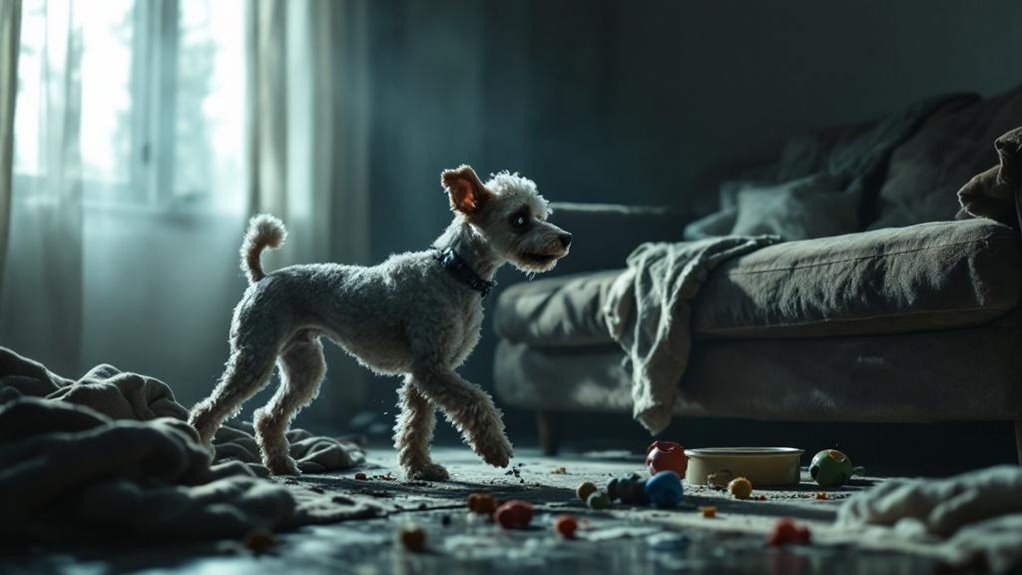
You may think your Poodle is just clingy, but severe separation anxiety often has clear signs you can test. If your dog panics when you leave, barks for long periods, tries to break out, or hurts itself, you need to act fast and in the right order. Some look-alike problems need a different fix. The next steps can help you keep your dog safe and start the right kind of support.
- Key Takeaways
- What to Do Right Now
- How to Tell if Your Poodle Has It
- Signs the Anxiety Is Severe
- When to Call Your Vet First
- Behavior Problems That Look Similar
- Why It Starts Suddenly
- Common Triggers at Home
- How to Calm Departure Cue Panic
- How to Start Separation Anxiety Training
- How to Build Alone Time Gradually
- How to Set Up a Safe Space
- Best Toys for an Anxious Poodle
- How Exercise Can Help
- How to Handle Greetings and Goodbyes
- When to Get Professional Help
- When Medication May Help
- Frequently Asked Questions
- Conclusion
Key Takeaways
- Put your Poodle in a secure, dog-proofed room or pen, not a crate if confinement increases panic or self-injury.
- Remove cords, sharp objects, and swallowable items, and give a frozen KONG or puzzle toy to reduce distress.
- Watch for severe signs like nonstop barking, escape attempts, drooling, trembling, destruction near exits, or accidents only when left alone.
- Schedule a veterinary exam, especially if symptoms started suddenly, to rule out pain, urinary issues, hormonal disease, or neurological problems.
- Get prompt help from a veterinary behaviorist, and ask your vet about proven medications like fluoxetine or clomipramine for severe cases.
What to Do Right Now
Act now to keep your Poodle safe and lower the panic. If your dog has severe separation anxiety, stop the risk first. Put your Poodle in a safe confined space like a sturdy pen or dog-proofed room. Remove sharp items and block exits. Skip a small crate if it makes panic worse.
Keep your Poodle safe first: use a secure pen or dog-proofed room, remove hazards, and avoid crates that increase panic.
Call your veterinarian right away. Ask about medical causes and short-term medicine that may help your dog settle while you start a plan.
Keep exits and returns quiet. Leave without a long goodbye. When you come back, wait for calm before you give attention.
Give a frozen stuffed KONG, a chew, or a food puzzle. Place it near problem spots.
If you can’t stay, set up supervised care today. Don’t leave your dog alone right now. A veterinary behaviorist can help if the panic includes nonstop barking, destruction, or self-harm.
How to Tell if Your Poodle Has It
Often, you can tell your Poodle has separation anxiety by what happens only when you leave.
If your dog exhibits barking, howling, or whining soon after you go, that points to distress, not disobedience. The same is true if a house-trained Poodle urinates or defecates only when alone.
Watch what your dog does near doors, windows, or gates. Destructive behaviors in those spots often mean your Poodle is trying to reach you, not just acting out.
You should also notice physical stress signs before you leave. Heavy panting, shaking, drooling, pacing, wide pupils, or refusing food can all signal fear.
A recent move, schedule change, loss, or adoption can trigger this pattern. If these behaviors fit, your Poodle may have severe separation anxiety and needs prompt support soon.
Using calm impulse control exercises like short mat work or wait training can also help your Poodle feel more settled.
Signs the Anxiety Is Severe
When the anxiety is severe, your Poodle won’t just fuss for a few minutes and settle down. You’ll see panic that lasts the whole time you’re gone. A dog with separation anxiety may bark or howl for hours, not stop after your exit.
| Sign | What you notice | Why it matters |
|---|---|---|
| Vocalizing | Barking or howling for hours | Ongoing panic |
| Exits | Chewing doors or digging windows | Destructive behaviors |
| Body stress | Trembling, drooling, panting | Physiological signs |
You may also find indoor accidents even though your dog was house trained before. If it happens only during absences and comes with stress signs, it points to severe separation anxiety. Frantic crate or gate escape attempts, especially with cuts or broken nails, also show severe distress. Short, reward-based routines can help your Poodle feel safer while you work on the underlying anxiety.
When to Call Your Vet First
Call your vet first if your Poodle’s separation anxiety starts suddenly or gets severe fast, because medical problems can look like behavior issues.
Ask before you try Benadryl, CBD, or any sedative, since the wrong drug or dose can make things worse.
If your dog vomits, has diarrhea, pants hard, trembles, or gets hurt when left alone, you need veterinary help right away.
A calmer home routine and quiet behavior training can also help reduce stress while you wait for professional guidance.
Rule Out Medical Causes
Before you label the problem as separation anxiety, have your vet rule out health issues that can look the same.
Indoor accidents, pacing, and barking can come from medical causes, not panic. Your Poodle may have a urinary infection, diabetes, Cushing’s disease, pain, or age-related cognitive or nerve problems. Sudden behavior changes need a vet visit.
- Track when signs happen and how often.
- Note diet, meds, supplements, drinking, vomiting, or weight loss.
- Ask if bloodwork, a urinalysis, thyroid, or adrenal tests fit.
- If tests are clear, ask for a veterinary behaviorist referral.
Bring a clear history so your vet can choose the right tests fast. Also ask whether current medicines increase urination or affect behavior.
If your dog is a puppy, teething discomfort can also increase chewing and restlessness, so age matters when sorting out the cause.
That helps you start behavior treatment on the right path and avoid missing a hidden problem first.
Ask About Medication
Given the risk of injury, ask your vet about medication right away if your Poodle is hurting itself, trying to break out, barking or howling for hours, or destroying things in a way that could cause harm.
Ask about proven anxiolytic options such as clomipramine and fluoxetine. These drugs often take several weeks to work, and they help most when you pair them with behavior training. If you may use medicine long term, ask for baseline bloodwork, including a CBC and chemistry panel. That gives your vet a safe starting point for monitoring and dose changes.
Also ask about short term event medications for hard departures or training sessions, and learn how fast they start and how long they last. Check side effects and interactions too. Don’t change or stop any medication without your vet’s guidance.
A strong routine and training plan can also make medication more effective over time.
Behavior Problems That Look Similar
While some signs can look the same, not every indoor accident or chewed item means your poodle has separation anxiety. Severe Separation signs can overlap with other issues, so watch when and where they happen. That helps you judge your dog’s anxiety and spot separation anxiety in dogs more accurately.
- Greeting leaks during play usually point to submissive or excitement urination, not alone-time panic.
- Small spots on walls or furniture suggest urine marking, not the larger messes linked to absences.
- Chewing from poor house training, youth, boredom, or low exercise often happens whether you’re home or not.
- Indoor accidents can come from illness. Get medical advice and rule out infections, diabetes, or incontinence before blaming anxiety.
Look for a pattern tied only to your departure. That clue matters most. Dog-proofing the home and providing safe chews can also help reduce chewing that comes from boredom rather than anxiety.
Why It Starts Suddenly
Separation anxiety can seem to start out of nowhere, but a recent change often sets it off.
If you’ve moved, changed your work hours, lost someone in the home, or brought your Poodle in from another home, you may have disrupted the routine your dog counted on.
Stress can make that change hit even harder, so the problem shows up fast.
A steady daily routine with regular feeding, potty breaks, play, and naps can help a Poodle feel more secure.
Routine Or Home Changes
Even small changes at home can start separation anxiety fast in a Poodle. Your dog depends on a steady routine, familiar spaces, and clear predeparture cues to feel safe when you leave.
- A work schedule shift can upset your Poodle within days.
- New childcare timing can change feeding, walks, and alone time.
- rehome/moving can remove familiar smells and room patterns.
- sudden changes like new shoes or a different door can matter.
You may notice problems after returning to work, changing exits, or rearranging furniture. These shifts break patterns your Poodle used to predict safety.
Even a new pet or a moved crate can confuse your dog. If anxiety starts all at once, look at what changed in your home first. Small fixes to routine and cues often help restore calm for your dog. Poodle temperament also plays a role, since many Poodles thrive on predictable routines and mental stimulation.
Loss, Rehoming, Or Stress
After a loss or sudden move, your Poodle may start showing strong anxiety with little warning. Dogs bond hard, so rehoming or the loss of a main person can feel like abandonment. Signs may appear within days or over a few weeks.
A work shift change, a move, or someone leaving home can also trigger separation anxiety. Even a dog that seemed stable can panic when daily cues change. Your Poodle depends on a predictable routine and familiar social patterns.
Grief can look like panic. You may see barking, pacing, chewing, or accidents indoors after a bonded person or pet is gone. Still, don’t assume stress is the only cause. Schedule a vet exam first. Pain, illness, marking, or house training gaps can mimic sudden separation anxiety signs in some dogs.
Common Triggers at Home
When life at home shifts, your Poodle may panic fast. Severe separation anxiety often spikes after a new work schedule, a move, or a change in caregiver. These changes can trigger distress within days.
Common triggers at home include:
- Departure cues like shoes, keys, or a coat, which can spark pacing, drooling, whining, or blocking the door.
- Confinement in a crate or closed room, especially if your dog can’t follow you, which may worsen escape attempts.
- Loud noises or a missing family member or pet, which can increase barking, howling, or self-injury.
- Long absences during full workdays, which often push severe cases into relapse without extra support.
Watch patterns at home. Triggers often stack up quickly.
How to Calm Departure Cue Panic
You can lower your Poodle’s panic by making predeparture cues like shoes, keys, and bags feel ordinary instead of alarming. Practice those cues without leaving, then build tolerance with very short absences and increase time slowly only when your dog stays calm.
Pair each practice departure with a special food toy so your dog starts to expect something good when you go.
Neutralize Predeparture Triggers
Start by taking the sting out of your poodle’s departure cues. Your dog learns that predeparture cues predict panic, so you need to break that link in daily life.
- Do leaving actions when you’re staying home.
- Reward calm behavior right away.
- Keep exits and returns quiet and plain.
- Randomize each step so cues lose meaning.
Try putting on shoes, then sit and read. Practice picking up your keys, then make tea. Grab your coat, then walk to another room. Randomize the order several times a day. Give a high-value treat or food puzzle when your poodle stays relaxed, sits, or lies down. Keep your voice, eye contact, and greetings neutral before and after absences. Pair this work with very short absences, and increase time only when your dog stays calm.
Practice Calm Cue Repetition
Next, practice the same departure cues in calm, short reps until they stop setting your poodle off. Repeat pre-departure cues without leaving. Put on shoes, pick up keys, then sit down. Do many cue-only trials each day and gradually increase variety, not intensity. Use low‑value rewards like kibble, not exciting games.
| Cue | Your response |
|---|---|
| Shoes on | Sit back down |
| Keys up | Drop one kibble |
| Coat on | Read for a minute |
Keep sessions under 5 to 10 minutes. Watch your dog closely and monitor stress signals like pacing, panting, yawning, or wide eyes. If stress rises, stop and make the next reps easier. Calm repetition teaches your poodle that these cues don’t always mean you’re leaving, so panic starts to fade over time.
Build Departure Tolerance تدريجيًا
Build departure tolerance in tiny steps so your poodle can stay calm and succeed. First, weaken strong cues that trigger separation anxiety. Pick up keys, put on your coat, or touch the leash many times a day without leaving until your dog stays relaxed.
- Practice predeparture cues in 10 to 30 short sessions daily.
- Start graduated departures at 1 to 2 seconds outside, then return calmly.
- Use counterconditioning with a stuffed KONG or lick mat only when you leave.
- Keep low-key departures and returns, and give attention after your poodle relaxes.
Track each session and use the 2× rule. Only double time after several calm repeats. If panic starts within 30 to 120 seconds, stop. Don’t push longer absences. Ask a veterinary behaviorist about supervised training and medication support.
How to Start Separation Anxiety Training
Begin with your vet, because pain, urinary problems, incontinence, or hormone issues can look like separation anxiety or make it worse.
Next, start desensitization with tiny exits. Step out for 5 to 30 seconds and repeat many times daily. Increase only when your Poodle stays calm several reps in a row. Add high-value counterconditioning. Give a puzzle toy or KONG stuffed with smelly treats only when you leave.
| Focus | What you do | Goal |
|---|---|---|
| Vet check | Rule out medical causes | Clear diagnosis |
| Short exits | Leave briefly, repeat | Calm practice |
| Treat setup | Use special food toys | Pleasant association |
| Cues | Pick up keys, coat, stay | Break trigger link |
If signs are moderate or severe, ask a veterinary behaviorist or certified applied animal behaviorist about treatment and possible anxiolytic medication.
How to Build Alone Time Gradually
Once your Poodle can handle very short exits, stretch alone time in small steps. Start with 30 to 60 seconds. Only increase the time by 10 to 20 percent after three calm trials.
- Do 10 to 20 short out-of-sight trials each day.
- Desensitize pre-departure cues by grabbing keys or a coat without leaving.
- Give a high-value distraction like a stuffed KONG during each short separation.
- If stress appears, go back to the last easy step.
Watch for pacing, drooling, or repeated barking. If you see those signs, don’t move forward yet. Slow down and repeat the last success until your dog stays relaxed.
As your Poodle improves, fade food rewards little by little. For severe cases, get help from a veterinary behaviorist. Be patient and steady every day.
How to Set Up a Safe Space
As you stretch your Poodle’s alone time, set up a safe space that feels familiar and easy to relax in.
Pick a small area your dog already likes, such as a gated corner of the living room. Skip the crate if it raises stress. Add a comfortable bed, water, and a worn T-shirt or blanket that smells like you. Don’t leave a full food bowl.
Choose a small, familiar space your Poodle already enjoys, with bedding, water, and your scent nearby.
Use long-lasting puzzle toys to keep your Poodle busy and encourage calm foraging. Keep the room softly lit. Turn on a radio or white noise at a low level so sudden sounds don’t stand out.
Make the area escape-proof. Secure doors and windows and block exits. Remove cords, sharp items, and anything your dog could swallow. If panic causes injuries, ask your vet or behaviorist about safer setup options.
Best Toys for an Anxious Poodle
You can help your anxious Poodle stay calmer with puzzle feeders, long-lasting chews, and scent toys that keep its mind and mouth busy.
Try a frozen food-stuffed toy or a chew-safe option for steady engagement, and use a puzzle feeder to add a short mental workout before you leave.
Snuffle mats and simple scent games also give your dog a calm job to do, which can make alone time easier.
Puzzle Feeders
Keeping your Poodle busy with a puzzle feeder can make departures easier. It gives you a clear food toy that shifts focus away from your exit and can stretch eating time from 10 to 30 minutes or more.
- Start easy with a treat ball, then move to sliding or rotating puzzles.
- Try a puzzle toy stuffed with kibble, pumpkin, or a little peanut butter.
- Freeze Kong fillings overnight to keep your dog working for 30 to 90 minutes.
- Rotate puzzle toys every few days so interest stays high.
Match the feeder to your Poodle’s size and skill. Watch first sessions so your dog doesn’t swallow pieces. Use puzzles during calm practice absences too, not only when you leave. That helps prevent the toy from becoming a departure signal later.
Long-Lasting Chews
Chew time can give your Poodle a steady job when you step out. Use long-lasting chew toys to turn nervous energy into focused work. A freeze-stuffed KONG can keep many Poodles busy for 30 to 90 minutes or more. That helps reduce stress and chewing on doors or furniture.
| Type | Example | Tip |
|---|---|---|
| Stuffable | freeze-stuffed KONG | Freeze wet food |
| Durable | durable chews | Replace when worn |
| Edible | bully stick | Supervise and limit |
You can also offer puzzle-dispensing chews like a Toppl or Wobbler-style toy for slow food release. Rotate a few safe options to keep interest high. Skip rawhide and fragile chews. They can break fast, cause blockage, or raise frustration. Always watch size, wear, and calories each day.
Scent Enrichment Toys
Food toys hold attention, and scent toys add another calm job for your Poodle. You can use scent work toys to channel foraging instincts and lower arousal before you leave. A snuffle mat or treat maze can keep your dog sniffing for 10 to 20 minutes, which often helps anxious behavior.
- Freeze a KONG Classic or Qwizl to extend licking and focus.
- Set up one hidden puzzle, one snuffle mat, and one food-dispensing ball.
- Rotate stations daily so your Poodle doesn’t get bored.
- Choose tough, non-toxic toys and supervise first sessions.
For severe cases, pair these toys with training. Give the toy only after your Poodle stays calm during a short practice departure. Then increase alone time slowly. That builds a better association with your leaving and helps.
How Exercise Can Help
Often, the right kind of exercise can make separation anxiety easier to manage in Poodles. You should use daily aerobic exercise, like 30 minutes of brisk walking, running, or active play, to lower pent-up energy and baseline stress.
Mental stimulation matters too. Try puzzle toys, scent games, or trick training for 20 to 30 minutes before you leave. Harder activity 60 to 90 minutes before absences often works better than mild movement.
| Exercise | Timing | Benefit |
|---|---|---|
| Brisk walk or run | Morning | Lowers anxiety |
| Puzzle toy or scent game | Before leaving | Promotes rest |
| Evening walk | Later daily | Adds routine |
Keep the routine steady each day. For severe separation-induced panic, pair exercise with behavior modification and veterinary support. Exercise helps, but it can’t solve everything alone.
How to Handle Greetings and Goodbyes
Usually, the way you leave and come home can either calm your Poodle or make the anxiety worse. Keep hellos and goodbyes quiet. When you return, ignore your dog for one to two minutes. Wait for calm, then reward it.
Quiet departures and low-key returns help your Poodle stay calm and make separations feel safe and routine.
Before leaving them alone, use a short settle routine. Give calm petting, a stuffed KONG, and a cue like “place” or “settle.” This helps your dog expect a relaxed pattern.
- Desensitize pre-departure cues like keys, coats, and leashes by picking them up without leaving.
- If your Poodle jumps or spins, step back and turn away.
- Reward only after four calm seconds.
- Practice brief exits and returns several times daily with a helper.
Keep each reunion low-key. That teaches your Poodle that comings and goings stay safe and ordinary every day.
When to Get Professional Help
Calm greeting routines help many dogs, but some Poodles need more support than home training can provide. If your dog shows self‑injury, repeated escape attempts, or ongoing destruction, seek professional help right away.
Start with your veterinarian. Ask them to rule out medical problems like urinary infections, hormone issues, or neurological disease before you begin intensive training. If your Poodle panics during very short absences, or if progress stalls after weeks, ask for a referral to a certified veterinary behaviorist or a Certified Applied Animal Behaviorist.
You should also get help fast if anxiety creates safety risks at home or makes you think about rehoming. In moderate to severe cases, ask for an evaluation for pharmacologic support along with a structured behavior plan for your dog.
When Medication May Help
If your Poodle still panics after steady training, medication may help lower the fear enough for learning to happen. You may need it when anxiety is severe and your dog injures itself, howls for long periods, tries to escape, or keeps destroying things despite behavior training.
- Your veterinarian should do an exam first and may run bloodwork.
- Common medications are used with training, like clomipramine or fluoxetine.
- Some dogs also need short acting medicine for specific departures.
- You should track progress and adjust the plan over time.
These drugs often take weeks to help fully. They don’t replace training. They support it. A veterinarian or veterinary behaviorist should choose the drug and dose. That gives your Poodle the safest, most useful plan possible.
Frequently Asked Questions
How to Break a Dog of Severe Separation Anxiety?
You break severe separation anxiety by getting veterinary and behaviorist help, starting meds if needed, preventing solo absences, desensitizing departures slowly, removing trigger cues, and rewarding calm with food puzzles while you monitor progress.
At What Age Does Separation Anxiety Typically Peak?
Picture two peaks: you’ll usually see separation anxiety rise most strongly during adolescence, around 6–18 months, often within the broader 6 months to 3 years window. You might also notice another peak later, after age 7.
How to Fix Poodle Separation Anxiety?
You fix poodle separation anxiety by seeing your vet, starting gradual alone-time training, desensitizing departure cues, using special food toys, increasing exercise, and avoiding long solo periods with sitters or daycare while treatment works.
What Is the 3-3-3 Rule for Dog Anxiety?
Like weathering a storm, you’ll see dog anxiety unfold in three stages: 3 days of acute stress, 3 weeks of adjustment, and 3 months of settling. You shouldn’t expect identical progress; every dog heals differently.
Conclusion
You can help your Poodle, even when the anxiety looks severe. Start with safety. Watch the signs. Call your vet if the behavior is intense or sudden. Keep goodbyes brief. Build calm routines. Add exercise and simple enrichment. Then get expert help if the panic keeps growing. One small change may not look like much at first. But if you stay steady and act early, the next time you reach for the door, things could feel very different.