
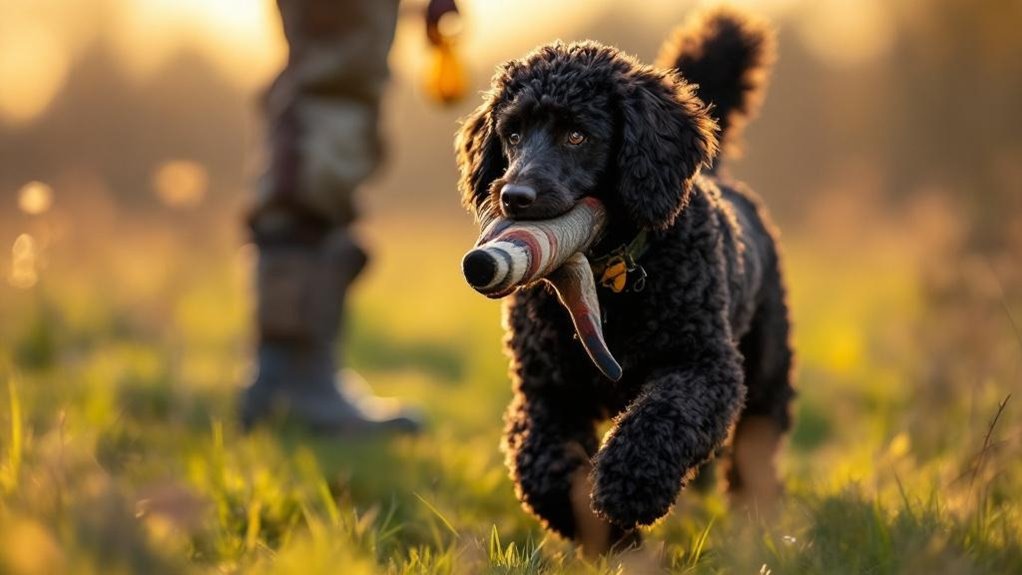
Like a decoy that shows where the birds will land, your Poodle’s first short retrieve can reveal what instincts are still there. You’ll often see strong drive for water, scent, and return, but you need to shape it with simple steps and good timing. Start with the right dog, the right age, and a vet’s approval. Miss those basics, and training can stall before the real work begins.
- Key Takeaways
- Why Poodles Retrieve Naturally
- What Hunting Instincts Poodles Still Have?
- Which Poodles Suit Hunting Best
- Get Vet Clearance First
- When to Start Retrieve Training
- Set Up a Safe Training Area
- Build Recall Before Off-Leash Work
- Use Fetch to Build Retrieve Drive
- Try the Natural Retriever Method
- Use Tug to Boost Motivation
- Teach Retrieves With Treat Toys
- Reward Calm Focus During Play
- Redirect Prey Drive Into Safe Games
- Train Water Retrieves Step by Step
- Protect Your Poodle in Cold Water
- Choose Helpful Training Gear
- Fit a Hunting Vest Correctly
- Avoid Common Retrieve Training Mistakes
- Build Hunting Skills From Retrieve Practice
- Frequently Asked Questions
- Conclusion
Key Takeaways
- Standard Poodles have strong retrieving and water instincts, with webbed feet, dense coats, and soft mouths suited for hunting and field work.
- Start retrieve training with short, easy tosses on land, reward every return, and keep sessions brief and frequent.
- Delay long swims and strenuous retrieves until growth plates mature, and get veterinary clearance before increasing intensity or water work.
- Use toys, tug, food rewards, and one consistent retrieve cue to build motivation and reliable returns.
- Choose working-bred Poodles with sturdy structure, boldness around birds, and strong play drive, since instinct and enthusiasm vary by individual.
Why Poodles Retrieve Naturally
Watch a Poodle fetch, and you can see how old hunting traits still shape the breed today. Poodles began as water retrievers, so you’ll notice traits that support retrieving from ponds and marshes. Their coats shed water, and their webbed feet help them swim with less effort.
Poodles still carry their water-retrieving roots, with water-shedding coats and webbed feet built for efficient swimming.
You also benefit from their soft mouths. Many Poodles can carry birds or toys gently and return them without damage. That trait came from selective breeding in working hunting dogs.
Their minds matter too. Poodles learn fast, read your cues well, and usually want to work with you. That makes fetch training smoother than it’s with many breeds. Simple nose work games can also build focus and reduce boredom.
Still, not every dog shows the same drive. You can build it early with water exposure, games, and short practice sessions.
What Hunting Instincts Poodles Still Have?
You can still see strong retriever drive in many Poodles, especially when they chase, carry, and bring items back to you.
You may also notice solid water work instincts, since many Poodles take to swimming with ease and stay confident in the water. With training, you can turn those natural habits into steady retrieving work.
Poodles often do best with short training sessions and clear, focused practice because they can stay engaged when the work matches their energy level.
Retained Retriever Drive
Remember what a Poodle was bred to do: retrieve birds from water. That history still shows in many Poodles today. You may see strong retriever drive, a soft mouth, and good marking when your dog watches a fall and goes straight to it. These traits support steady training and clean carries on land.
Poodles also learn fast. You can teach retrieves, blinds, and hand signals with short, clear sessions. Keep practice consistent because smart dogs can get distracted. Their coat was shaped for hard outdoor work and supports stamina during cold or muddy retrieves.
Still, not every dog brings the same natural drive. If your Poodle seems less enthusiastic, build motivation with play, tug, or food rewards. A treat-stuffed toy or tug-to-throw game can create a reliable retrieve over time. Their reliable obedience can also help them stay focused during hunting drills.
Water Work Instincts
That retriever drive often shows up most clearly in water, where many Poodles still act like true waterfowl dogs. You’ll often see strong water-retrieval instincts, easy swimming, and quick fetches from ponds or marsh edges.
- Use short throws first, then build distance slowly.
- Add long lines or fenced water for control and safety.
- Consider a neoprene vest for buoyancy, warmth, and protection.
Poodles were bred for this work. Their dense coat resists water, and a working clip leaves insulation on the chest and joints. That helps with cold water and debris.
In Dog Training, expect fast learning and smart problem-solving. Still, your dog may get distracted. Keep sessions simple. Start with short retrieves and increase length over time. Lean dogs may benefit from side-float vests on longer swims.
A calm four-paws-on-the-floor approach can also help keep water retriever sessions focused and controlled.
Which Poodles Suit Hunting Best
Start with a Standard Poodle if hunting is your goal. Standard Poodles keep the water drive, swimming power, and retrieving instinct you need for real hunting skills.
You should favor proven working lines over pet-only breeding. Ask a professional dog trainer which titles matter most and look for steady dogs with strong focus.
| Type | Best use | What to seek |
|---|---|---|
| Standard | Ducks, upland | Working lineage |
| Miniature | Light retrieves | Less drive |
| Toy | Not ideal | Limited stamina |
| Cross | Versatile field work | Pudelpointer influence |
Pick a dog with a deep chest, sturdy joints, and a moderate coat you can trim for water and brush. You also want boldness around birds, strong play drive, and quick response to your cues.
Early positive reinforcement and short, consistent sessions help a young poodle build focus and confidence without overwhelming its limited attention span.
Get Vet Clearance First
Getting vet clearance comes before any retrieving or water work. Ask for written vet clearance that says your poodle can train safely. Your vet should check for orthopedic issues, growth plate concerns, breathing problems, and ear infections that training could worsen.
- Ask about hips, elbows, ears, skin, and coat health.
- Review weight, diet, and body condition for safe swimming.
- Get written limits if your dog has surgery, illness, or medication.
This matters even more for puppies. Their joints are still developing, and hard work can cause harm. Your vet should also look for hot spots, sebaceous cysts, and wet-coat problems that can affect comfort and safety. If your poodle has a past injury or chronic condition, get clear activity rules before you add retrieves, water, or long-line sessions. Poodles are also prone to separation anxiety if they are not taught to handle alone time gradually.
When to Start Retrieve Training
You can start basic retrieve games when your Poodle is about 8 to 10 weeks old, as long as your vet says it’s safe.
Watch for simple readiness signs like chasing a soft toy, picking it up, and wanting to come back to you.
Keep early sessions short and easy, use very short tosses in a fenced area or on a long line, and save longer retrieves, water work, and added weight for full maturity. Short daily practice with calm rewards can help your Poodle build impulse control while learning to retrieve.
Ideal Puppy Age
Building a retrieve habit can begin at 8 to 10 weeks with soft toys and very short tosses, which helps your Poodle learn mouth control without putting stress on growing jaws. For any young dog, Retrieving requires patience and steady repetition.
- Start with soft toys and close, easy tosses.
- Keep sessions short, about 3 to 5 minutes.
- Add rewards like food or tug play.
At 12 to 16 weeks, you can make practice a bit more structured in a fenced area or on a long line. Keep each session brief to protect growth plates and prevent fatigue.
Train several times each day instead of doing one long session. That fits your puppy’s short attention span. Before you raise intensity under six months, ask your vet. Wait on long swims or heavy pulls until growth slows.
Keep toy names clear and consistent during short play sessions so your Poodle can learn to distinguish each object more easily.
Readiness Signs
Usually, a Poodle is ready to start retrieve training when your vet says light activity is safe and your dog shows a clear interest in chasing, carrying, or holding toys.
For puppies, that often means gentle work after 8 to 12 weeks, once key growth milestones are on track.
You should also see strong play drive, like tugging, ball focus, or carrying objects. Many Poodles show natural abilities early. That matters.
Your dog should also know basic obedience and come when called in a quiet area. A fenced yard or long line helps you check that.
Handling matters too. Your Poodle should accept a collar or vest and let you touch the mouth and chest without fuss.
If your dog can enjoy several 5 to 10 minute sessions, you’re seeing essential training techniques for a future Hunting Dog.
Keeping your Poodle mentally enriched can also reduce boredom and unwanted chewing while you build training readiness.
Safe Early Progression
Starting early works best when you keep it gentle and low impact. After your vet clears your puppy, begin with short play sessions, about 5 to 10 minutes, a few times each day. This protects growing joints and bones while building interest in retrieves.
- Use soft, light toys on flat ground
- Keep your pup on a long line or in a fenced area
- Watch for stiffness, fatigue, or reluctance
For young Poodles, toss a stuffed toy or soft ball only a few feet. Add distance slowly as recall improves.
This matters for Hunting safety too, because chasing can trigger strong instincts. Use treats or tug to reward effort. Don’t force repeated hard retrieves. Save water work for physical maturity, often 12 to 18 months in larger Poodles, with shallow supervised entries.
Set Up a Safe Training Area
Before you train, ask your vet to clear your poodle for retrieving or water work so you don’t miss joint, growth plate, ear, or heart problems that exercise can worsen. Then make sure your dogs work in a fenced space.
| Check | Why |
|---|---|
| Fence or long line | Prevents escapes |
| Non-slip ground | Reduces falls |
| Remove hazards | Avoids cuts |
| Shallow water entry | Eases starts |
| Shade and water | Limits heat stress |
Use grass, packed dirt, or rubber mats. Clear brush, thorns, holes, glass, and wire. For water, pick a calm shore with a solid exit. Fit a float vest if your poodle swims. Keep sessions short. Puppies do three 5 to 15 minute lessons daily. Adults can do 15 to 20 minutes. This careful setup supports a versatile gun dog.
Build Recall Before Off-Leash Work
Reliable recall comes first if you want safe off-leash work. Get veterinary clearance before intense practice, especially for puppies with growing joints. Start in a fenced area with a leash or long line. Keep sessions short, about 10 to 15 minutes, and repeat them morning, mid-day, and evening.
Safe off-leash starts with reliable recall, short sessions, and a secure fenced space using a leash or long line.
- Use a cheerful rocket recall cue every time.
- Pay with high-value rewards like meat treats or tug.
- Start at 5 to 10 feet, then add distance and light distractions.
Build success in small steps. Let your poodle sniff briefly, then call back. Practice an emergency recall with a separate one-word cue and your very best reward. Increase distractions slowly. Move to off-leash work only when your dog returns fast and reliably in secure places under light pressure.
Use Fetch to Build Retrieve Drive
Once your poodle comes back to you on cue, you can use fetch to build a stronger retrieve. Start with very short throws, about 2 to 5 meters, and use a soft, easy-to-see toy. Dogs love clear games, so praise every return or give a great treat.
Keep puppy sessions short, about 3 to 6 minutes, and repeat them a few times daily. Use a fenced area or long line. That protects joints and keeps success an important part of training.
If your poodle drops the toy early, sit down and act excited about it. Reward any step toward you. At the time of this writing, a toy stuffed with treats or a tug reward also helps low-drive dogs. Add distance and mild distractions only after short retrieves look solid.
Try the Natural Retriever Method
Start in a fenced area or on a long line, and toss a soft toy just a few feet while you use the same retrieve cue each time. Praise your Poodle when it picks up the item and comes back, and make the return fun so it wants to place the toy in your hand.
Hold the toy for a moment before each throw, then vary praise, treats, or a quick game so you build desire without rushing.
Start With Short Tosses
Keeping it simple helps your Poodle learn to retrieve with confidence.
Start with tosses just 2 to 6 feet away. Use a soft ball or small stuffed toy. Let your dog watch the toss, give a clear cue, and praise any interest right away. Poodles are smart family dogs and always seek clear feedback, not confusion or pressure.
- Keep puppy sessions to 3 to 5 minutes.
- Train in a fenced area or on a long line.
- Add distance by 1 to 2 feet after calm success.
If your puppy is young, keep tosses very short to protect growing joints. Reward success with treats, praise, or a brief tug.
If you train near water later, use water-safe toys and a fitted vest.
Ignore strange tips like enable JavaScript prompts online.
Encourage The Return
Now teach your Poodle that the game ends with coming back to you. Work in a safe, enclosed space or use a long line. Toss a soft ball or small stuffed toy only a few feet. Give a clear retrieve cue. Praise any interest so your dog connects the cue with the game.
If your Poodle drops the toy, sit down and act very enthusiastic to get it. Be patient. Make the toy seem valuable. This often triggers the chase back to you.
The key is the payoff. When your dog returns with the object, reward at once. Use a treat, a brief tug, or open a treat-filled toy. Keep sessions short, especially with puppies. Do several 5 to 10 minute sessions, watch for fatigue, and get vet clearance first.
Build Desire Through Suspense
Before you throw, build a little suspense so the toy feels important. Let your poodle see the ball or small stuffed toy. Pause, lean forward, and show that a throw is coming. This raises the toy’s value and makes your dog want the chase.
- Start with very short tosses and use the same retrieve cue each time.
- Reward the return at once with a treat or brief tug game.
- If your dog drops the toy, sit down, pat your legs, and call it in.
Keep sessions short and frequent. Work in a fenced area or use a long line. That helps your poodle stay with the game. As returns get reliable, throw a little farther. Add distance slowly. Build focus first, then add challenge around mild distractions later.
Use Tug to Boost Motivation
Often, a short, sturdy tug toy can help you build a Poodle’s drive for retrieving. Start with 30 to 60 seconds of tug, so the toy becomes high value before you ask for a fetch.
After you win a brief tug match, toss the toy 5 to 15 yards and cue “fetch.” When your dog returns, reward the effort with more tug. If your Poodle hangs onto the toy, don’t pull it away. Call your dog in with claps and upbeat recalls, then toss again to get movement back toward you.
Keep the game short and low impact, especially for puppies. Use several 5 to 10 minute sessions each day. As skill grows, throw farther and mix tug rewards with praise, so your dog gives the toy reliably.
Teach Retrieves With Treat Toys
Sometimes a treat-filled toy makes retrieving click for a Poodle because the toy itself starts to predict food.
Use a small Velcro or pouch toy. Pack it with high-value freeze-dried meat bites. Don’t give the treat until your dog returns the toy to you.
- Toss the toy only a few feet in a fenced area or on a long line.
- Give one clear retrieve cue, then open the toy and feed right at delivery.
- If your dog drops it early, sit down and reach for it to trigger a go-back.
Keep sessions short. Build success first. Then increase distance and add mild distractions.
Reinforce every correct return at the start. Later, reward some returns instead of all. With puppies, go slowly and protect growing joints. As the habit sticks, trade food for tug or play.
Reward Calm Focus During Play
Use play to teach self-control, not just speed. During tug or ball, ask for a 2 to 3 second sit or a calm mouth before you restart the game. Your poodle learns that calm focus makes fun happen.
When your dog returns with the toy and settles near you, mark it and give a high-value treat like freeze-dried meat. That builds a strong link between calm proximity and reward.
Keep formal play short. Do 3 sessions a day for 5 to 15 minutes. Stop while your dog is still attentive and calm.
If tug turns mouthy or wild, pause for 5 to 10 seconds. Start again only after relaxed posture or eye contact.
Over time, stretch the calm wait from 3 seconds to 10 to 20.
Redirect Prey Drive Into Safe Games
You can redirect your poodle’s prey drive with structured chase games like tug, a flirt pole, or a safe ripping game that lets your dog stalk and chase without going after wildlife.
You should reward calm returns with a strong recall cue and high-value rewards, so coming back to you becomes part of the fun.
You can also use safe retrieve outlets like water retrieves, ball fetch, and short fenced chases to meet those instincts while keeping control.
Structured Chase Games
A few simple chase games can channel your poodle’s prey drive into safe play. Use short chase patterns like orient, stalk, then run in a fenced area or on a long line. That gives your dog the fun parts while you control space and time.
- Toss-tug-toss builds a controlled chase and retrieve
- Rip-and-reward satisfies grab and possess safely
- Sit or drop-and-wait adds impulse control before release
Keep each round short and easy to repeat. Win a brief tug, then throw the toy 10 to 30 yards. You can also use a Velcro treat toy or rag for tearing. Ask for a two to five second wait before the next throw. Train your emergency recall cue on its own, then use it during high-energy games until your dog turns back fast.
Reward Calm Returns
Calm returns turn chase play into a game you control. Pair every retrieve with an immediate high-value reward that stays with you. Use a great treat or a short tug session. Your poodle learns that bringing the object to your hand pays fastest.
Train on a long line or inside a fence. Guide your dog back gently so you don’t trigger more chasing. Then reduce help as calm returns reach eight or nine out of ten tries.
If your poodle drops the toy early, sit down and ignore it. Call calmly and show the reward. This teaches an open-mouth exchange at your hand.
In high prey-drive moments, build suspense before the throw. Reward only the calm delivered return. Also teach one emergency cue and protect its value with top rewards.
Safe Retrieve Outlets
Often, the safest way to redirect prey drive is with short, supervised retrieves in a fenced area or on a long line. Keep throws 10 to 30 feet. Use soft water-safe balls or small stuffed toys. This lets your poodle chase and carry without losing control.
- Reward any step back to you to teach “bring” and “give.”
- Use brief tug, then toss the toy 5 to 15 feet and restart tug only after the return.
- Try food-filled toys or treat pouches for dogs that care more about food than toys.
Open the toy or release the tug as the reward. That builds clean handoffs. You can also use simple Predation Substitute games, like stalk, stand, then retrieve. Always pair emergency recalls with your highest-value rewards every single time.
Train Water Retrieves Step by Step
Begin on land, then move to water only after your vet clears your poodle’s joints and you’ve set up a long line or a fenced shoreline for safety. This matters most for puppies with growing bones.
Start in shallow, calm water. Toss a floating dummy or ball only a few feet. Give your retrieve cue. Praise every return so your dog learns the full sequence.
If your poodle drops the item near you, sit low on the bank or in the water. Reach out and call your dog in. Reward hand-offs with treats, tug, or play.
Add distance slowly. Later, add mild current or decoys. Use a snug neoprene vest with a strong handle.
If water drive is low, use a treat toy or short tug to reward returns consistently.
Protect Your Poodle in Cold Water
You’ll protect your Poodle better in cold water if you use a 5mm neoprene vest that adds warmth, buoyancy, and a layer against ice and hidden sticks.
Make sure it fits your dog’s deep chest and narrow waist so it stays snug, doesn’t rub under the legs, and works as it should.
Start with short practice sessions so your Poodle gets used to the vest before you rely on it in the field.
Cold-Water Vest Fit
When water turns cold, fit matters as much as insulation. Measure your Poodle’s girth, neck, and body length before you buy. Choose 5mm neoprene and a model that suits a deep chest and narrow waist. Good options include adjustable Versa-Vest styles or dive-cut neoprene.
- Pick six-point adjustments or trim panels for a snug fit.
- Check leg holes and armpits for sagging or rubbing.
- Look for a paracord handle, metal loop, and tough chest panel.
Use dual-lined neoprene with cordura or rubberized chest protection. It helps guard against brush and ice. Test the vest on land first. Practice putting it on and taking it off. Let your dog wear it during short brush runs. Recheck fit each season as coat and weight change.
Warmth And Floatation
Often, your Poodle needs help holding body heat and staying high in cold water. Keep more coat over the joints, and trim the belly and hindquarters. That keeps warmth, cuts drag, and helps prevent scrapes.
A 5mm neoprene vest adds insulation and lift. Dual-lined neoprene, cordura edging, and side flotation pads matter most for lean dogs.
| Feature | Helps how | Why it matters |
|---|---|---|
| Coat pattern | Holds heat | Cuts drag too |
| 5mm vest | Adds float | Slows chilling |
| Handle, leash loop | Lift fast | Less cold stress |
Use a vest with a paracord handle and metal leash loop so you can steady or lift your dog fast. Start vest sessions in short steps. Ask your vet before hard cold-water work with puppies.
Choose Helpful Training Gear
What gear helps most at the start? Begin with control and clear rewards. Use a sturdy 20 to 30 foot long line and a properly fitted harness, not just a collar. This keeps early retrieves safe while your poodle learns recall.
- Long line and harness for safe practice and steady management
- Floating dummies, stuffed toys, and tug rope for realistic retrieves
- Waterproof treat pouch with high-value bites for fast reinforcement
Choose bumpers that match waterfowl size and float well. Neoprene or rubberized bumpers work well in water. Bring a durable insulated water jug and a tough bowl so your dog stays hydrated. Pack easy-to-dose treats, such as freeze-dried bites, to reward quick returns and emergency recall. Good gear keeps sessions simple, safe, and consistent every time outdoors.
Fit a Hunting Vest Correctly
Good gear helps, but the vest has to fit right to do its job. Measure your poodle’s girth at the widest part of the rib cage, the neck, and the length from the base of the neck to the tail. Pick a trim-able or multi-adjust vest that matches those numbers.
Set the vest high on the chest, but don’t block shoulder movement. Keep the leg holes and belly panels snug, not tight, so your dog can swim and run.
Fasten every strap and Velcro point. Center the flotation pads on the sides, and keep the handle over the spine so the vest won’t sag or twist.
Watch for rubbing at the armpits or neck. Re-adjust straps or trim neoprene edges. Use short practice wears so your poodle gets comfortable.
Avoid Common Retrieve Training Mistakes
When you teach retrieve work, don’t rush into long or hard throws. Start with short tosses, about 6 to 15 feet, and get vet clearance before you ask a young or untested poodle to do more. This protects growing joints and keeps sessions safe.
- Use a long line or a fenced area until recall and return are steady.
- Don’t scold for drops; sit down and warmly reclaim the toy.
- Fade food rewards over time and use praise or tug instead.
Keep your dog close enough to succeed. Don’t let off-leash freedom create bad habits during the return.
Also, avoid only straight, easy throws. Change distance and angle. Hide the item lightly in cover or toss into shallow water. Variety keeps your retrieve work reliable.
Build Hunting Skills From Retrieve Practice
Build hunting skill through your poodle’s retrieve work by keeping each throw short, simple, and easy to win at first.
Use a soft ball or small stuffed toy and toss it only a few feet. Go slowly, especially with puppies, to protect growing joints and build a steady return. Work on a long line or in a fenced area until recall is solid. Then add more distance and light distractions.
If your poodle won’t fetch on its own, use a food-stuffed toy or a brief tug game to spark interest. Reward fast delivery with treats or another tug. Praise hard on the return.
If the toy drops, sit still and act unable to reach it. That often encourages hand delivery. Later, add water retrieves with floatable gear and a fitted neoprene vest.
Frequently Asked Questions
Can Poodles Earn Hunt Test Titles Without Regular Field Hunting?
Yes, you can earn hunt test titles with your poodle without regular field hunting. You’ll need consistent training, strong retrieving skills, and practice on test elements, but organized sessions and events can prepare you successfully.
How Do Apartment Owners Satisfy Retrieving Instincts Indoors?
You can satisfy retrieving instincts indoors by playing hallway fetch, using soft bumpers, teaching directed retrieves, rotating puzzle toys, and practicing scent games. You’ll burn energy, sharpen focus, and keep your apartment-friendly dog fulfilled daily.
Are Poodles Compatible With Other Pets Despite Prey Drive?
Yes, you can usually keep poodles with other pets despite prey drive, especially with early socialization, supervision, and training. You should introduce them gradually, manage interactions carefully, and stay cautious around very small animals.
How Much Daily Mental Work Prevents Obsessive Chasing Behaviors?
Like a telegraph, you’ll curb obsessive chasing with 30–60 minutes of daily mental work: scent games, obedience drills, puzzle feeders, and retrieval practice. If your poodle still fixates, you should increase challenges and structured exercise.
When Should a Professional Trainer Be Involved?
You should involve a professional trainer as soon as chasing escalates, recall fails consistently, or your dog shows anxiety, aggression, or fixation. Don’t wait for habits to deepen; early coaching helps you regain control faster.
Conclusion
Trust your Poodle’s natural drive, but shape it with patience and control. Start small, keep sessions short, and protect growing joints. Use the right gear, check fit, and watch for fatigue, sore ears, or coat trouble. Don’t rush water or distance. Build one skill at a time. Done well, training becomes a steady bridge from play to useful field work. Your dog learns to retrieve with confidence, and you gain a calm, reliable hunting partner over time.